The Bible Shows Why Prayer Doesn’t Work

Illuminated (illustrated) manuscript I think I’ve figured it out!  The Bible itself makes clear why prayer doesn’t work, and the clues are all from within the same gospel, Matthew.
I’ve heard stories of people in fast food restaurants who aren’t content to simply pray to themselves but stand and pray aloud for everyone’s benefit.  Jesus isn’t keen on these pretentious people.

When you pray, do not be like the hypocrites, for they love to pray standing in the synagogues and on the street corners to be seen by others. Truly I tell you, they have received their reward in full.  But when you pray, go into your room, close the door and pray to your Father, who is unseen. Then your Father, who sees what is done in secret, will reward you.  (Matt. 6:5–6)

But later in the same book, Jesus says something different.

If two of you on earth agree about anything they ask for, it will be done for them by my Father in heaven.  For where two or three gather in my name, there am I with them.  (Matt. 18:19–20)

There’s the problem—prayer requires both a gathering and being by yourself.
No wonder it never works!
Photo credit: Wikipedia
Related posts:


Word of the Day: Hoare’s Dictum

C.A.R. Hoare and his wife stand outside Buckingham Palace after he was knighted by the queenSir Charles Hoare was a pioneer in computer science.  He observed:

There are two methods in software design.  One is to make the program so simple, there are obviously no errors.  The other is to make it so complicated, there are no obvious errors.

This applies to logical arguments as well: you can make the argument so simple that there are obviously no errors.  Or you can make it so complicated that there are no obvious errors.
A simple, straightforward argument for God’s existence might be, “Of course God exists.  He’s sitting right over there!”  Many arguments claim to be simple and straightforward—“the Bible is obviously correct” or “God obviously exists” for example—but are mere assertions rather than arguments backed with evidence.
Lots of apologetic arguments fall on the wrong side of this Hoare’s Dictum.  The Transcendental Argument, for example, is often a five-minute dissertation about what grounds logic and whether a mind must exist to hold it.
The Ontological Argument goes like this.  First we define “God” as the greatest possible being that we can imagine.  Two: consider existence only in someone’s mind versus existence in reality—the latter is obviously greater.  Three: since “God” must be the greatest possible being, he must exist in reality.  If he didn’t, he wouldn’t meet his definition as the greatest possible being.
When hit with an argument like this for the first time, you’re left scratching your head, unsure what to conclude.  These arguments are effective not because they’re correct (in fact, they fall apart under examination) but because they’re confusing.
The colloquial version of the argument is:

If you can’t dazzle ’em with brilliance, then baffle ’em with bullshit.

Photo credit: Microsoft
Related posts:

Related links:

  • Hoare’s Dictum” has been defined in computer science as, “Premature optimization is the root of all evil,” so perhaps this use should be Hoare’s Second Dictum.

Stephen Hawking Speaks

Here’s an excellent video (43:39) inspired by Hawking’s latest book, The Grand Design. It’s quite approachable, but it does get into some apologetics-relevant topics like, Does the Big Bang demand a Creator? and Can something come from nothing?
Hawking says that it doesn’t and it can.

Related posts:

Escape from the Creation Conference (2 of 2)

Statue of triceratops with a saddle from the Creation MuseumThis is the second of two posts about the Reality-Distortion Zone that is a Creationist conference.  Read the first one here.
The second lecture was by a science teacher.  He injected more than a dozen Bible quotes and Christian imagery into what was otherwise a decent astronomy lecture.
The irony was lost on him.  He used videos, animations, presentation software, a PC.  He showed Hubble photos of galaxies and satellite photos of solar flares.  He lauded the Apollo program.  This was science revealed to us by technology built on science.  He made a good case—science delivers!
One video took us on a five-minute trip through the universe, accelerating from Earth past the solar system, Alpha Centauri, our galaxy, and our local group of galaxies to eventually take in the entire universe.  And the ancient prescientific desert tribe that made up the Genesis account was stuck back there on Earth 3000 years ago, trying to make sense of things with their Iron Age worldview.
There was yet more unacknowledged irony when he emphasized the size of “God’s creation.”  The Bible says, “[God] also made the stars” (Gen. 1:16).  That’s it.  That’s all the Bible says about the 99.9999999999999999999999999% of the universe1 that’s not the earth.  Makes you think that the authors of Genesis didn’t know about the vastness of the universe.
He played the audio of Apollo 8’s famous Christmas Eve 1968 reading of Genesis 1:1–10.  According to that passage, here’s what God was up to on the second day:

And God said, “Let there be a vault between the waters to separate water from water.”  So God made the vault and separated the water under the vault from the water above it.  And it was so.  God called the vault “sky.”

See if that sounds like this: “[They] envisioned the universe as a closed dome surrounded by a primordial saltwater sea.  Underneath the terrestrial earth, which formed the base of the dome, existed an underworld and a freshwater ocean.”  This was the cosmology of the Sumerians, who preceded the Jews by centuries.
To me, the Apollo reading of this prescientific view of nature doesn’t sound majestic but is meaningful only as it highlights what we’ve discarded.
The speaker made the obligatory slam of Continue reading

I Survived the Creation Conference (1 of 2)

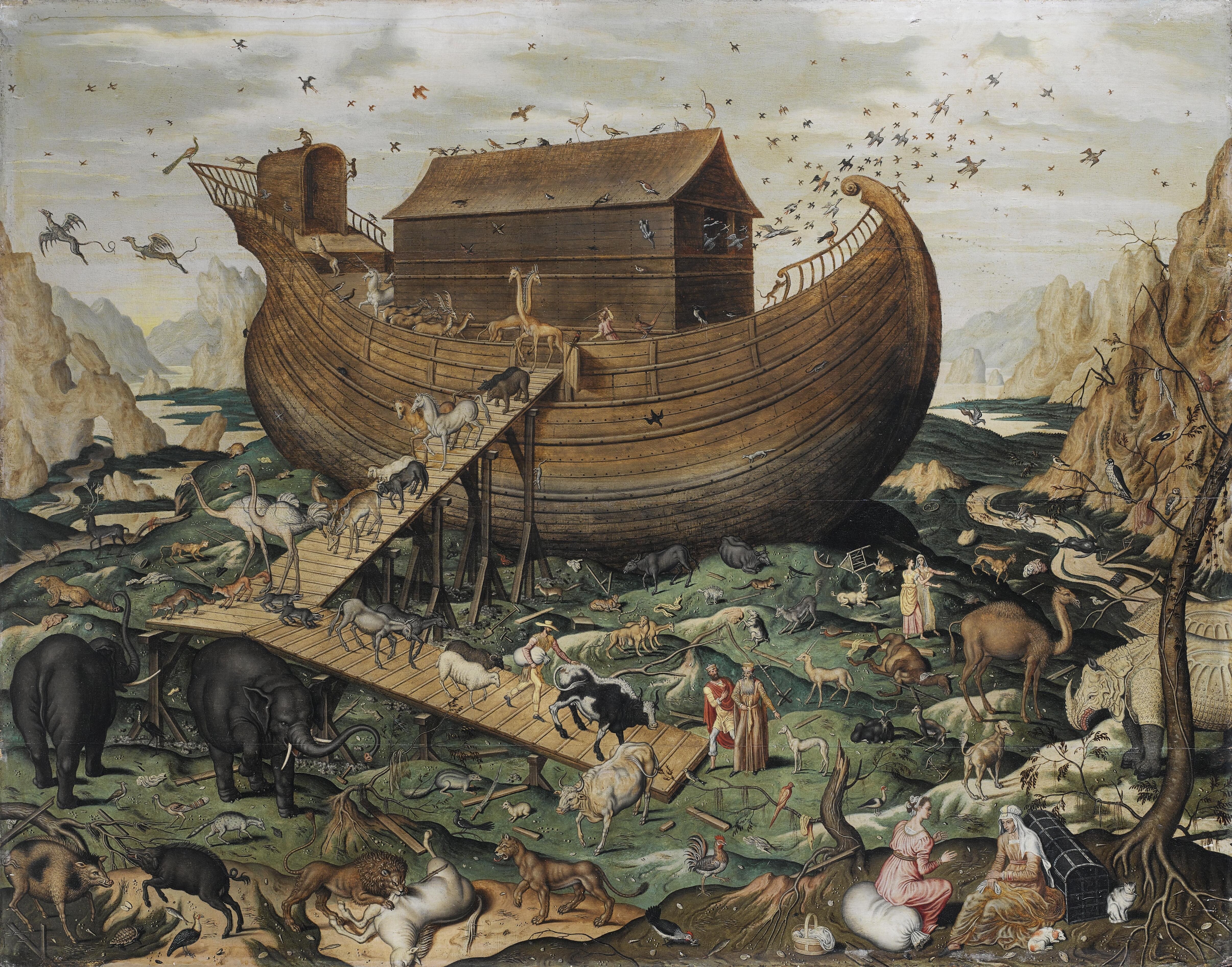
Noah's ArkI attended the 2011 Seattle Creation Conference and made it out to tell the tale.
The slogan of the conference was, “Dedicated to glorifying God through the scientific study of His Creation and refuting the false claims of Evolutionism.”  (Is it just me or does that last phrase betray a presupposition?)  There were prayers galore, sometimes both opening and closing a single lecture.
If the speakers were confident that science will eventually support the biblical view, they could let the science speak for itself.  They could show confidence that science will lead us to the biblical answer.  The question, “If Science and Scripture diverged, which one would you follow?” came to mind, but the answer was obvious.
This was a young-earth Creationism conference.  “Young earth” means: the earth is less than 10,000 years old.  “Creationism” means: evolution is nonsense.  There were probably some old-earthers there too, but I’m pretty sure that I was the only one stupid enough to accept the scientific consensus on evolution.
The remainder of this post is about lectures by Mike Oard from Creation Ministries International, who spoke for two hours on Noah’s flood.  (Let me add that everyone was polite, including me, so I’m attacking the “science,” not the speakers.)
Oard began with a couple of Bible quotes to justify using reason.  It’s odd to need such a justification in a conference “dedicated to … scientific study,” but OK.  One quote was, “Examine carefully; hold fast to that which is good” (1 Thes. 5:21).  I suspect that the last phrase was seen as license to pick and choose.
He stressed that, while some Christians imagine this to be a local flood, it was global.  I enjoy seeing Creationists attack each other, but Continue reading

Only 21 More Shopping Days Till the End of the World!

That’s right, boys and girls—the world will end one month from today on October 21, 2011.  There’s not much time left to finish those nagging last-minute chores!
Of course I’m referring to Harold Camping’s predicted Rapture on May 21 and the end of the world 153 days* later.  Not a lot happened on the “Rapture” and, as Armageddons go, the one we’re in right now seems quite mild.  Camping’s predictable backpedaling reframed May 21 as “an invisible judgment day.”
Camping’s Family Radio organization came out of this fiasco financially strong, but many of his followers spent their retirement savings to spread the word during the run-up to May 21.  Camping has done nothing to correct the harm he’s caused, and some have called for a fraud investigation.
Camping hasn’t learned from his public humiliation and is holding fast to his date for the end of the world.  He said, “It won’t be spiritual on October 21st.  The world is going to be destroyed all together, but it will be very quick.”**
Many Christians, embarrassed that Camping spoke for their religion, quoted Matthew 24:36 to argue that Camping is unable to make a prediction about the end.  In this verse, Jesus says:

But about that day or hour no one knows, not even the angels in heaven, nor the Son, but only the Father.

Christians also quote another verse: “The day of the Lord will come like a thief in the night.…  Destruction will come on them suddenly, as labor pains on a pregnant woman” (1 Thessalonians 5:2–3).  But Camping can quote the very next verse:

But you, brothers and sisters, are not in darkness so that this day should surprise you like a thief.

Aha—the true Christian like Camping apparently can know the end!
Or maybe the Bible is simply a sock puppet that can be made to say anything.
Photo credit: Wikipedia
Continue reading