Word of the Day: Shermer’s Law

Christianity and atheism clash againI propose “Shermer’s Law” for this observation by Michael Shermer: “Smart people believe weird things because they are skilled at defending beliefs they arrived at for non-smart reasons.”1
This observation makes an important distinction between (1) how someone came to their beliefs and (2) how they later defend those beliefs.  People often come to their beliefs for poor reasons—for example, they may be racist or religious simply because they were raised in that environment.
Few will admit as an adult, “Oh, yeah—I don’t believe that for any better reason than that I was steeped in that environment, and I’m now just an unthinking reflection of that environment.”  Instead, they use their intellect (much more formidable now that they’re an adult) to marshal a defense of their beliefs.  The belief comes first, and the defense comes after.  And this isn’t just to save face with an antagonist; it’s to save face with themselves.
We can come up with a defense for just about anything.  It may not be a very good defense, but it’s something, and it may be sufficient to avoid cognitive dissonance (“Surely I believe this for a good reason, right??”).  The smarter you are, the better the defense you will come up with.
All of us do this, and (this may be consolation) the smartest people can do it more spectacularly than the rest of us.  Isaac Newton wasted time in alchemy, Nobel laureate Linus Pauling in vitamin C research, and Nobel laureate William Shockley in eugenics.
No one’s immune, but this is common in Christians who cobble together rationalizations for their beliefs.  “In for a penny, in for a pound” is easier than taking a step back to soberly consider the logic of the beliefs.  And the smarter the Christian, the better they can defend groundless beliefs.
Try to uncover this by asking, “You’re giving me an argument for Christianity, but is this what convinced you?  If not, why don’t you give me the argument that made you a Christian?”
Photo credit: Wikimedia
1 Michael Shermer, Why People Believe Weird Things (Freeman, 2002), p. 283.
Related posts:

Related links:

Five Emotional Pro-Choice Arguments

In the last post, I argued for a spectrum from a single cell (not a person) to a newborn baby (a person).  This is in response to pro-life advocates who deny this spectrum to argue that we have a “baby” from newborn all the way back to that single cell.
I’d like to make five arguments in favor of my position.  To do that, I’ll try to bypass the intellect to some extent and appeal to emotion.
1. Child vs. Embryos.  Suppose the fertility clinic were on fire, and you could save either a five-year-old child or ten frozen embryos.  Which would you pick?
Of course, everyone would save the child.
But now imagine the same situation two years later.  The ten embryos have become one-year-old babies and the child is now seven years old.  Which would you save?  Obviously, the ten babies.
As an aside, note that the decision in the second instance is much tougher.  In the first, we lost ten insensate embryos, but in the second, it’s a child.  No one equates a newborn or a child with an invisible clump of cells.
2. Different Reactions to Abortion Procedures.  Anti-abortionists focus on the horror of a late-term abortion.  Did you ever wonder why they don’t focus instead on a woman swallowing a Plan B (emergency contraceptive) pill?  Or a drug-induced abortion (the most common procedure for first-trimester abortions)?  Imagine anti-abortion activists carrying signs, not with a photo of an eight-month-old fetus but with life-size drawings of a 100-cell human blastocyst.  The signs would appear blank.
By choosing as they do, they admit that all procedures are not equal and that there is a spectrum.  Their story is more powerful the older the fetus is.  A blastocyst is very unlike a person, but an 8-month-old fetus is very much like a person.
3. Slaughtering Animals for Food.  Which would be more horrible to watch: a woman swallowing a pill of Plan B or a cow going through a slaughterhouse?  The cow can experience fear and pain, while the single cell can experience neither.  The cell’s claim to superiority is only its potential to be a person.
There’s a big difference from what is and what might be.  A blastocyst has impressive potential but has vastly fewer cells than the brain of a fly.  The only trait it shares with a person is its DNA, a vague and abstract commonality.
And there’s no guarantee that our imagined cell will develop properly during pregnancy.  A single cell might become a human baby or not, just like betting $1000 on black at the roulette table might win or not.  With half of all pregnancies ending in spontaneous (natural) abortion, the odds for each are about the same.
4. Cloning and Skin Cells.  Imagine that in ten years we are able to clone a human from a single skin cell.  Would you never scratch your skin to avoid killing a potential human being, like the Jain who wears mesh over his face to avoid accidentally breathing in a flying insect?  And if not—if “potential human being” is very different in your mind from “human being”—then why not see that same difference between a single cell and a newborn baby?
5. Saving Another Person’s Life.  If a blastocyst is a person, would you give up your life for it?  You might risk your life to save a stranger; is the same true for a stranger’s blastocyst?
What we value changes across this spectrum, and, while we might intellectually argue that a human is a human is a human, emotionally we don’t see both ends of the spectrum the same.
Let me make clear that I’m simply arguing for the existence of a spectrum.  We can agree on this and still disagree on when the okay/not-okay line is for abortion.  The status quo seems to resolve this well: society decides on the upper bounds and then allows girls and women to choose.
Show me why a single fertilized human egg cell is equivalent to a trillion-cell newborn.  It’s not equivalent in any important biological sense; why should it be equivalent morally?
Next time: What’s Wrong with the Pro-Life Position?
Photo credit: ebmarquez
Related posts:

The “God is Simple” Argument

In The God Delusion, Richard Dawkins said, “God, or any intelligent, decision-making calculating agent, is complex, which is another way of saying improbable.” But is God complex? Philosopher Alvin Plantinga argued that he is not:

According to much classical theology (Thomas Aquinas, for example) God is simple, and simple in a very strong sense.… So first, according to classical theology, God is simple, not complex.

Seriously? We’re consulting a 13th century scholar to understand modern cosmology? Modern science takes us to the Big Bang, and we need Thomas Aquinas to figure out the remaining riddles?
Here’s philosopher William Lane Craig’s input:

As a mind without a body, God is amazingly simple. Being immaterial, He has no physical parts. Therefore to postulate a pure Mind as the explanation of fine-tuning is the height of simplicity!

So anything that isn’t physical is simple? Sure—something that isn’t physical is maximally simple physically because it doesn’t exist physically. But that doesn’t help us with immaterial things, whatever they are. I don’t know what it means to be an immaterial mind, so I have no way of evaluating its complexity. Incredibly, neither apologist gives any evidence of the claim that God is simple. They seem to have no way of evaluating its complexity either and propose we just take their word for it.
Of course, science has shown that complex can come from simple. For example, we see this in the formation of snowflakes, in erosion, or in evolution. From a handful of natural rules comes complexity—no intelligence required.
But we’re talking about something quite different—an intelligent creator. And in every creative instance we know of (the creation of a car, the creation of a bee hive, the creation of a bird’s nest), the creator is more complex than the creation. Plantinga’s God would be the most stupendous counterexample to the axiom that, in the case of designed things, simple comes from complex, and yet we’re supposed to take this claim on faith.
But there’s a way to cut through all this. Is God as simple as Plantinga or Craig imagine? Then demonstrate this—make us one. Humanity can make complex things like a microprocessor, the worldwide telephone system, and a 747, so making this “amazingly simple” thing shouldn’t be hard. Or, if we don’t have the materials, they can at least give us the blueprints.
Surely they will fail in this challenge and admit that they have no clue how to build a God. In that case, how can they critique the simplicity of such a being? Now that their argument that God is simple has evaporated, we’re back to Dawkins’ argument that a complex God is improbable.
Photo credit: Wikimedia
Related links:

  • Alvin Plantinga, “The Dawkins Confusion (A Review of Richard Dawkins’s The God Delusion),” Christianity Today, March 2007.
  • William Lane Craig, “Dawkins’ Delusion,” Reasonable Faith, 2009.
  • “Divine Simplicity,” Wikipedia. (Note: neither Craig nor Plantinga accept this view.)

Word of the Day: Systems and Wicked Problems

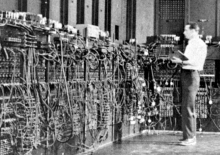
Lots of wires, but ENIAC didn't replace GodWe all deal with systems—computers, cars, or communities, for example—and a few concepts may help see things a little more clearly.
This is an excerpt from another book of mine, Future Hype: The Myths of Technology Change.
 

Perfection means not perfect actions in a perfect world,
but appropriate actions in an imperfect one.
— R. H. Blyth

Systems are difficult to work with, and seeing things for what they are is an essential first step.  Horst Rittel in the late 1960s distinguished between “tame” and “wicked” problems.  This is not the distinction between easy and hard problems—many tame problems are very hard.  But wicked problems, while not evil, are tricky and malicious in ways that tame problems are not.  The unexpected consequences we’ve seen have been because systems problems are wicked.  We will understand systems better—and why they spawn unexpected consequences—if we understand a little more of the properties of wicked problems and approach them with appropriate respect.
Tame problems can be clearly stated, have a well-defined goal, and stay solved.  They work in a Newtonian, clockwork way.  The games of chess and go are tame.  Wicked problems have complex cause-and-effect relationships, human interaction, and inherently incomplete information.  They require compromises.
For example, mass transit is a wicked problem.  Everyone likes mass transit—unless it comes through their neighborhood, it consumes road lanes, or they have to pay for it.  The difference between something that works in the lab, on paper, or in one’s head versus something that works in the real world and is practical to real people is a characteristic only of wicked problems.
Tame and wicked problems differ in many ways.*  See if the traits of wicked problems as described below sound familiar, either with the examples mentioned here or with situations you have experienced yourself.

  • Problem Definition.  A tame problem can be clearly, unambiguously, and completely stated.  Math problems are tame.  By contrast, there is no absolute statement of a wicked problem.  To state a wicked problem means to also state its solution.  That is, the problem can’t be stated without a proposed solution in mind, and coming up with a new solution means seeing the problem in a new way.  Avoid locking in a problem definition too soon.
  • Goal.  A tame problem has a well-defined goal, such as the QED in a proof or the checkmate in chess.  With a wicked problem, you could keep iterating and refining your solution forever—or go back and consider other solutions.  After all, if a wicked problem is something you can’t define, how can you tell when it’s resolved?  You don’t stop because you’re done (you’ve reached the goal) but rather because of external constraints (you’ve run out of money, time, or patience, for example).  You must strive for an adequate solution, not a perfect one.
  • Solutions.  Solutions are unambiguously correct or incorrect with tame problems.  The solution to a wicked problem is not judged as correct or incorrect but somewhere in the range between good and bad.
  • Time.  The solution to a tame problem can be judged immediately (that is, there is no maturation time), and the problem stays solved.  Euclid’s geometry proofs are still valid today.  Evaluating the solution to a wicked problem takes time (because the results of implementing the solution take time to be appreciated) and is subjective.  Is that a good design?  Maybe, but maybe not.  Like the response to art, different people will have different answers, and the solution causes many side effects (unintended consequences), like medicine in the body.  Additionally, a “solved” wicked problem may not stay solved—wicked problems aren’t solved but are only addressed; they’re treated, not cured.  Your perception of how good the solution is may change over time.
  • Consequences.  Trial and error may be an inefficient approach with a tame problem, but it won’t cause any damage.  Implementing or publicizing a proposed solution doesn’t change the problem.  With a wicked problem, however, every implementation changes reality—it’s no longer the same problem after an attempted solution.  After a failed attempt, the solution you realize you should have tried may now not work.
  • Reapplying Past Solutions.  A class of tame problems can be solved with a single principle.  A general rule for finding a square root or applying the quadratic formula will work in all applicable cases.  By contrast, the solution to a wicked problem is unique.  We can learn from past successes, but an old solution applied unchanged to a new problem won’t produce the old result.  Many unexpected consequences arise when we rush to reapply (without customization) a particular solution we’ve seen before—there will likely be unseen differences between the old and new problems.
  • Problem Hierarchy.  A tame problem stands alone.  It is never a symptom of a larger problem, but a wicked problem always is.  For example, if the cost of something is too high, this can be a symptom of the higher-level problem that the company doesn’t have enough money.  Often, we can’t see the higher-level problem (“This new software is terrific!  I can’t imagine what could be better.”).

Systems are large, complex, and real-world, and they are the domain in which technology is applied.  Industry’s dreams and expectations for its new high-tech products are formed in the lab, but it is in the system of society that they’re put to use.  This brief summary of wicked problems as well as these cautionary examples give some insight into the inherent difficulty of meddling with systems.  This is not to say that we can’t address systems problems but that they should be approached with caution and respect.
Let’s end this chapter with a final example of unexpected consequences due to technology.  In the 1954 short story “Answer,” Fredric Brown envisions many great scientists working for years to build a giant computer network, connecting the computing power of billions of planets.  As the inaugural question for this technological marvel, the gathered dignitaries ask, “Is there a God?”
The computer doesn’t hesitate before answering, “There is now!” 

Everything has both intended and unintended consequences. 
The intended consequences may or may not happen;
the unintended consequences always do.
— Dee Hock, president of VISA

* Rittel and Webber, “Dilemmas in a General Theory of Planning,” Policy Sciences, 4:155–169, 1973.

Photo credit: Wikimedia
Related posts:
The Christian Message

The Thinking Atheist has put together another high-quality and humbling video (humbling because this sets the bar very high for the rest of us trying to add to the discussion).
Here’s the Christian message told in a frank but sympathetic way (4:16).
https://youtube.googleapis.com/v/1Rwioe1SGkQ

Word of the Day: CE and BCE

How does the dictionary define "morality"?  There's no objective there.It’s easy to overlook how recent our calendar system is.  Our Gregorian calendar is defined by a number of features: that this is the year 2011, that we use a solar calendar of 12 months, “30 days hath September” and all that, that the year starts roughly 10 days after the winter solstice, the calculation of the leap year, and so on.  Developed during the reign of Pope Gregory XIII, it was introduced into Roman Catholic regions beginning in 1582, but it wasn’t adopted by the British Empire (including America) until 1752, and it wasn’t the world’s predominant calendar system until China adopted it in 1949.
Year 1 must be fixed to some point in history, and myriad dates have been used (and are still being used).  Dionysius Exiguus (Dennis the Short) in the 6th century used the birth of Jesus as the starting point, and this has been the custom in the West since.  Unfortunately, Dennis was off by a few years, and Jesus is now thought to have been born 4–6 years before year 1.
So how do we label years 1 and following?  The Anno Domini (year of our lord) label for this era gradually came into vogue centuries after Dennis, and BC (Before Christ, for the years before) came in later still.
International standard ISO 8601 specifies date and time representations, but it uses plus and minus signs instead of BC and AD.  Unlike conventional dating, it doesn’t bypass the year 0.  Year 10 AD is written as 0010 (4 digits are always used for the year), and year 10 BC becomes –0009 (because of the addition of year 0).
The convention that has become widespread is the use of CE (Common Era) to replace Anno Domini and BCE (Before Common Era) to replace Before Christ.  “Common Era” has been used in English in this sense for over 300 years.  This convention is seen as a way to eliminate outdated religious baggage from the calendar, though there are objections.  Indeed, it was opposition to this convention that prompted the formation of the Conservapedia wiki.
Photo credit: Wikimedia
Related posts: