
Design Hypothesis: DNA and Dysteleology

Creationism, evolution, and the Design HypothesisDysteleology is the idea that life or nature does not show compelling evidence of design, in contrast to the Christian perception of purpose or design (teleology). Recent discoveries in DNA verify that life looks more haphazard than designed.
Let’s consider four aspects of DNA that make it look not designed.
DNA Size
Human DNA has 3.42 billion base pairs. You might imagine that humans need the most DNA since God(s) said, “Let us make man in our image,” but we’re not even at the top of the list of mammals—cows, mice, and bats have more.
And mammals don’t have as much DNA as other animals. One kind of salamander has 126 billion base pairs in its DNA. Does it really need 37 times more DNA than humans? Or is there a lot of waste?
There’s quite a bit of variability in fish DNA. The longest DNA (for the marbled lungfish) is almost 400 times the size of the smallest (the green puffer fish).
There are grasshoppers, beetles, ticks, worms, and snails that have more DNA than we do. There are plants that have more than we do—the onion, for example, has five times more. The record holder, with 400 times more DNA than humans, is a protozoa.
The wide variability in DNA size is shown in this chart:
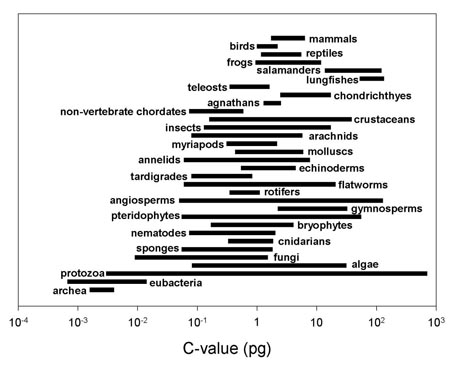
This is a logarithmic chart of the weight, or c-value (a proxy for DNA length), of the DNA of many categories of animals. Humans are in the “mammals” category at the top.
Either DNA is all useful and length is proportionate to the complexity of the organism—and many animals are much more complex than we are—or there’s a lot of waste in DNA. That’s not a clue to a designer.
Pseudogenes
All mammals synthesize vitamin C. They produce it internally and don’t have to eat it. All mammals, that is, except a handful, such as humans. We get scurvy if we go too long without eating vitamin C.
When you look in human DNA, you find a pseudogene (a broken gene) for vitamin C production, right where most other mammals have a functioning gene. Apparently, ancestors of humans (and a few other primates) once ate a diet rich in vitamin C so that a random mutation that broke the gene didn’t convey a selective disadvantage. The pseudogene spread through the population, and here we are, with every cell carrying a useless gene.
Smell is another area where humans have a lot of pseudogenes. Of our roughly 100 odorant receptor genes, most don’t work. Many other mammals have working versions of these pseudogenes. At the other end of the scale is the dolphin, which has no working odorant receptor genes. They’re all pseudogenes.
Overall, human DNA has 20,000 pseudogenes—again, not evidence of the hand of a designer.
Endogenous Retroviruses
A virus can’t reproduce by itself and must force a cell to do it, which causes disease. Where it gets weird is when the virus infects a germ cell (egg or sperm). Then the viral DNA, usually inactivated by mutation, is passed on to succeeding generations. Becoming part of the genome is the “endogenous” part.
DNA keeps a record of these invasions. Human DNA has thousands of endogenous retroviruses, mostly just fragments, which compose 8% of our genome. One, the 5-million-year-old “Phoenix virus,” was intact enough within human DNA that it has been reconstructed.
Atavisms and Vestigial Structures
Birds don’t have teeth, but their ancestors did. In fact, the ancient genes for teeth are still present in bird DNA. Scientists have been able to tweak chicken DNA to turn on these genes and get chickens with conical, dinosaur-like teeth.
When archaic genes are switched on in nature, those are called atavisms. Snakes can have legs, dolphins can have a hind pair of limbs, and people can have tails.
Vestigial structures are those that have lost most or all of their ancestral function. Note that they’re not necessarily useless (Creationists delight in pointing out the value in the human appendix or tailbone); they’re just not used for what they were originally used for. For example, ostrich wings are vestigial because they can’t be used to fly (that’s what wings do).
Other examples are eyes in blind mole rats or cave fish, the pelvis (for nonexistent legs) in the baleen whale, and goose bumps (to raise nonexistent fur) in humans.
None of this proves that God doesn’t exist. What it does make clear is the difference between complexity, which we do see in DNA, and evidence of a careful and skillful designer, which we don’t.

Yes, evolution by descent from a common ancestor is clearly true.
If there was any lingering doubt about the evidence from the fossil record,
the study of DNA provides the strongest possible proof
of our relatedness to all other living things.
— Francis Collins, evangelical Christian and head of NIH

Photo credit: U.S. National Library of Medicine

How Likely the Jesus Miracle Stories?

Weighing souls, like we must weigh the evidence for God and JesusChristianity makes some fanciful claims: Mary was a virgin when she gave birth to Jesus. Jesus turned water into wine. He raised Lazarus from the dead and was resurrected from the dead himself. He is God, one with the creator of the universe.
One response to these claims is simply to dismiss them. Let’s instead see how probability can be applied to questions like this. Christians and non-Christians won’t easily agree because they won’t agree on the various probabilities. Still, an understanding of conditional probability will give us a powerful analytical tool to at least better understand these claims.
Richard Carrier (whose Skepticon video was helpful in my understanding of this material) says that conditional probability “is the mathematical model for all correct reasoning about empirical claims.”
An Example: Medical Test
Start by imagining a test for a disease that is 95% accurate. That is, it is positive 95% of the time for someone who has the disease and negative 95% of the time for someone who doesn’t. Now imagine a common disease—10% of the population has it, so in a thousand people, 100 have it and 900 don’t.
Now give them the test. For the 100 sick people, the test gives 95 positives and 5 (false) negatives. And for the 900 healthy people, it gives 855 (900 × 0.95) negatives and 45 (false) positives.
Suppose the test says that you have the disease. How worrisome is that?
You’re in one of the two groups of people with positive test results. You’re either one of the 95 who actually do have it or one of the 45 who don’t but got a false positive. The chance that you’re sick is the number of sick people who test positive divided by the total number of positives: 95/(95 + 45) = 0.68.
The probability is 68% that you have the disease.
Let’s recap: what’s the probability that you (or any random person) has the disease? 10%. But what’s the probability given that you have a positive test result? It’s 68%. That’s conditional probability—the likelihood of something given (conditional upon) something else, some additional information.
Make the test ten times more accurate and a positive test results means a 96% chance that you have the disease. Instead—and here’s where it gets interesting—make the disease one tenth as common and your likelihood of having the disease given a positive test result is 16%. Make it very rare—one in a million—and that likelihood becomes just 0.005%.*
Visual Approach to the Same Problem
Let’s explore the original problem but visually.

Bayes Theorem in medical situation

This tree is just a recap of the previous problem: we start with 1000 people, then divide them into two groups based on what we know initially (the probability of a person being sick is 0.1), and finally process this with new information, the test whose probability of a right answer is 0.95.
Applying Probability to the God Question
Let’s move on to the God question (I’m using an example from Richard Carrier’s video).

We start with 1000 universes, places where we imagine God to exist or not. In step 2, our initial assumption about the God claim is to be generous. Knowing nothing about this “God” guy, let’s start by saying that the likelihood of his existence is 50% (P(G) means “probability of God”). In step 2, this gives us two possibilities, with 500 universes in each.
In step 3, we add our new evidence. In the medical example, the new evidence was the result of a test, and here it’s the existence of evil in our world—birth defects, natural disasters that kill thousands, slavery and other immoral institutions, and so on. This evil exists, and yet no god is doing anything about it. What is the likelihood that a benevolent God could exist but still accept the evil in our world?
We have plenty of examples of benevolent beings: the noblest humans. They’re not perfect, but we could assume that a perfectly benevolent being would be at least as benevolent as a good human. Try to imagine a benevolent human (1) who could prevent bad from happening, (2) wouldn’t be harmed for taking this action, but (3) didn’t do anything. That’s pretty inconceivable. Let’s say that the probability of this happening is one in a million. Let’s be conservative and assign the same probability of standing by and doing nothing to a perfectly benevolent god.
That’s the P(e|G) = 10–6 in the diagram above: the probability (P) of the evidence of evil (e) given (|) the existence of God (G) is one in a million (10–6).
The 500 universes on the left side of the tree have to be divided given the probability of such a god existing given the existence of evil. Only one in a million could have a god (~0 means “almost zero”).
It’s easier on the right side of the tree. The likelihood of evil existing in a godless universe is 1.
Conclusion: the existence of evil makes God very improbable.
But … God Could Have an Excuse
In response, the Christian may say that God has an excuse for not acting. Yes, he’s benevolent, but he’s also omniscient, and our finite minds must simply be unable to understand the justification for his inaction.
That doesn’t help, and the tree shows why.


Consider step 3. The conditional probability is now 1. The apologist assumes some unspecified, inconceivable (by our finite brains) reason why God has his own justifiable reasons for allowing evil. But this means we’re looking for something else. We’ve gone from searching for God (G) to searching for “God who has unspecified, inconceivable reasons to allow evil” (G′).
As you can see from step 2, this simply moves the problem around. We had nothing to go on before, so we just assigned a generous 0.5 probability for God (P(G) = 0.5). But now we have a more refined goal that can be evaluated. Now, we’re looking for a very particular God (G′), a very unlikely God, a one-in-a-million God.
Conclusion: making excuses for God makes him less likely. First you must imagine (despite the lack of evidence) supernatural beings, then those with sufficient power to create the universe (deities), then assume that there are benevolent ones that interact with us, then imagine this one-in-a-million deity who has this inconceivable excuse to allow evil.
The mathematics of conditional probability has been applied here to the question, How likely is God given the existence of evil? We could also ask, How likely is the virgin birth given the existence of other virgin birth stories that preceded Jesus that would’ve been known in Palestine? Or, How likely is the resurrection given the existence of stories of other dying-and-rising gods?
This approach will probably never resolve a debate between a Christian and a non-Christian because they won’t be able to agree on probabilities. However, it does give structure to the argument and highlights the unknowns.

Oh, I know He works in mysterious ways,
but if I worked that mysteriously I’d get fired.
— caption for Bob Mankoff cartoon

Appendix: Bayes’ Theorem
We have been using Bayes’ Theorem, though it is more commonly known as an equation. To see that this tree structured approach is an equivalent (and more intuitive) approach to the equation, let’s convert the medical test example above into equation form.
In that example, we first imagine a population of 1000 people and then (step 2) use the likelihood of the disease (10%) to divide that population into sick and well and then (step 3) further divide those populations into those who got positive and negative test results.
Our goal is P(s | p), the probability (P) of being sick (s) given (|) a positive test result (p). Bayes Theorem says that this is computed as follows:

where ~s = the probability of not being sick.
This looks imposing, but you’re already familiar with these values. Look at the numerator first, a measure of how likely s (being sick) is to be the case:

  • P(p | s) = the probability of a positive result given that you’re sick = 0.95 (that is, a likelihood of 95%)
  • P(s) = the probability of a random person being being sick = 0.1 (the incidence is 10% in the population)

The denominator measures all possible results, your being sick and your being well. It’s the sum of the numerator (the sick likelihood) and its opposite (the not-sick likelihood), which is composed of:

  • P(p | ~s) = the probability of a positive test result given that you’re not sick (that is, a false positive), which is 0.05 (our example was simple, with false positives and false negatives both at 5%, but in the general case they would be different)
  • P(~s) = the probability of not being sick = 0.9. This one is not a variable since P(~s) = 1 – P(s).

Put these values into the equation: 0.95×0.1/(0.95×0.1 + 0.05×0.9) = 0.67857. This is what we got above with the simpler and more intuitive 95/(95 + 45).
* Here is the math behind those probabilities:
99.5/(99.5 + 4.5) = 0.957
9.5/(9.5 + 49.5) = 0.161
1/(1 + 20,000) = 0.00005
Photo credit: Wikimedia

The Cross Examined Podcast!

In the hopes of reaching a wider audience, I’m now recording my blog posts as a podcast.
If you listen to the Skeptoid podcast, you’ll find a lot of similarities. I’ve been inspired by Brian Dunning’s minimalist style.
The podcast content is identical to the blog, just delayed by a week or so. If, like me, you like to listen to interesting or provocative information while doing something else, this might be the right medium for you. Do you have friends who prefer podcasts to blogs? Let them know!
Expect three podcasts per week of 5–10 minutes each.
A Little Help, Please?
If you use iTunes and want to support the podcast, help me get it off the ground with some positive ratings. First click on the iTunes button below:
Cross Examined
At the iTunes page, click on the blue “View in iTunes” button just below the artwork. That will bring up the iTunes app on your computer, where you can click on “Ratings and Reviews.”
(If a rating of 4 or 5 stars isn’t what you had in mind, then forget I said anything!)
This podcast thing is new to me, so if you can think of any suggestions to making the podcast better, please let me know. Are there any podcast directories that I should register with? Any way to improve the appearance or spread the word?
Thanks!

You have your way.
I have my way.
As for the right way, the correct way, and the only way,
it does not exist. 
— Friedrich Nietzsche

(Need the RSS feed address? Here it is.)

Why Worry About a God That Isn’t There?

What should atheists call themselves?
I get this a lot. “Why do you worry about something you don’t even think exists? Why call yourself an atheist?”
That’s a reasonable question. People with no God belief may not call themselves atheists for lots of reasons. Maybe they prefer another name like freethinker, skeptic, or agnostic. Maybe they want to focus on what they do believe in and so think of themselves as humanists or naturalists. Julia Sweeney prefers the label “naturalist,” to make someone who disagrees with her take the position a-naturalist. Maybe, as the cartoon suggests, not believing in God is as irrelevant to their lives as not believing in unicorns or Santa Claus.
But I do call myself an atheist. God belief impacts society in ways that unicorn belief or Santa belief never could. In the list of Christian excesses below, see if you agree that only religion—and not mere belief in mythical beings—could provoke these actions.

  • The Pope says that condoms shouldn’t be used in Africa to stop the spread of HIV.
  • U.S. preachers provoke death-penalty legislation for homosexuality in Uganda.
  • Some churches forbid birth control among their members.
  • Stem cell research is held up.
  • Young women are urged not to get the HPV vaccine that protects against cervical cancer.
  • In-vitro fertilization, which has brought four million children to parents unable to conceive, is attacked by the Catholic church.
  • Some Christians push for Creationism to be taught in science class, for Christian prayers to be said in public schools, and for the Ten Commandments to be displayed in courthouses.
  • Christian belief seems to be a requirement for public office, despite the fact that the Constitution makes clear that no religious test shall ever be required.
  • Prayer allows people to pretend that they’ve actually done something … so they no longer feel the need to get off the couch and actually do something.
  • William Lane Craig dismisses life on earth, the only life we know we have, as “the cramped and narrow foyer leading to the great hall of God’s eternity.”
  • Sex education in many schools is constrained by religion, not guided by best practices.
  • A mother tried to kill herself and her two children to avoid Harold Camping’s Armageddon. Others donated their life savings to Camping’s ministry to make themselves right with God.
  • Texas Republicans call for an end to teaching critical thinking in public schools.
  • Televangelists fleece gullible people.
  • Religion dismisses inconvenient truth. In a March 2012 poll of likely Republican voters in Alabama, 45% said that Obama is a Muslim (14% said Christian), and 60% did not believe in evolution (26% do accept evolution).
  • Prayer is great when you can put your burdens at the feet of Jesus, but not so great when nothing happens. Then you need to wonder what’s wrong with you that God isn’t answering. Mother Teresa wrote about her wavering faith, “[it makes me] suffer untold agony.”
  • African children have been killed or injured because someone supposed them to be witches.
  • And isn’t it enough that religion encourages belief in something that isn’t true?

If Christianity could work and play well with others, that would be great, and I’d find other activities to occupy my time. But it doesn’t.
This is why I call myself an atheist. Many of the alternate labels are also available to a Christian antagonist. Like me, they might call themselves freethinkers, skeptics, humanists, or agnostics. But they won’t call themselves atheists.
If you’re a Christian reading this, you may respond that your church doesn’t do this. In that case, agree with me! Agree that Christian excesses cross the line and must be kept in check.

Kill them all.
For the Lord knows them that are His.
— advice from church leader Arnaud Amalric (d. 1225)
to a soldier wondering how to distinguish friend from enemy

This is a modified version of a post that originally appeared 9/26/11.
Artwork credit: Mike Stanfill

Weak Analogies Don’t Prove God

don't use weak analogies for Jesus beliefI’d like to suggest an analogy that Christians would do well to avoid.
Here’s one instance of it.

A man found the girl of his dreams. She was intelligent, beautiful, and she loved him. He was convinced that she was the perfect mate. He wanted to marry her. But he never asked her. So, they were never married. Wanting to be married doesn’t make it so. You have to decide and then act.
Our situation with God is something like that. We feel the God-shaped vacuum. We desire relationship with him. We hear that Christ’s sacrifice makes that relationship possible by paying the price for our wrongdoing.
But the relationship will never happen unless we decide and then act.

As Beyoncé observed, “If you like it, then you shoulda put a ring on it.” Take the plunge. Make a leap of faith and commit to Christianity.
I don’t find the story compelling, but that’s not my point. My point is that I don’t find the story logical. What’s the girlfriend doing in the story? How is that relationship relevant? Jesus is like the perfect girlfriend … that you just never get around to committing to? And if you’re shy or noncommittal, couldn’t your girlfriend (or Jesus) suggest getting married?
No, this story is not at all what the Christian claim is like. Here’s a better parallel:
A man wanted to settle down with someone special, and his friend Paul told him about a girl he knew, Diana. Paul described her as intelligent, beautiful, caring, and the perfect mate. The guy was eager to meet her and asked Paul to arrange it, but Paul kept giving excuses—she was busy, she had to reschedule, she was out of town, and so on. But Paul said that she was also eager to meet.
As our hero continued to ask about the mysterious Diana over subsequent days, Paul responded with more excuses and gave her increasingly New Age-y attributes: Diana had lived past lives, she could sense the future, she could move things with her mind. And then ever-more fanciful skills: she could materialize objects, she could heal in seconds after an injury like Wolverine, she could fly like Superman.
Our hero has now lost interest. This tale sounds like an invention, even like fiction. He doesn’t imagine that Paul would deliberately lie to him, but Paul’s story has few characteristics of an authentic biography.
Why should he imagine that Diana exists, especially when she looks invented and his pleas for evidence turn up nothing? Wonder Woman doesn’t exist; the Wicked Witch of the West doesn’t exist; why imagine that Diana does? Yes, the man really wants a great woman in his life, and yes, this one sounds pretty amazing. But why imagine that she even exists?
And that’s the problem with these “Jesus is like” or “God is like” analogies. The least interesting feature of the Christian girl-of-his-dreams story is that the girl actually existed. Well, duh—it’s hardly a remarkable claim.
And yet existence is the central feature of the claim about Jesus or God. Somewhere very early in that story must be some variant of, “Okay, I know this sounds pretty fanciful. I know God sounds just like all those other gods that we both agree don’t exist. But this one’s different! Let me tell you why.”
Don’t pretend that one’s relationship with a person is like that with God. Christians should avoid this analogy.

I choose not to draw vast conclusions
from half-vast data.
— Dr. Jerry Ehman

Photo credit: Wikipedia

Top Religion Story of 2012

Are Christians more generous than atheists?Bill Donohue is president of the Catholic League. I’ve responded before to his hatred of same-sex marriage and his annoyance at the consequences of living with a secular Constitution.
But today Bill is all smiles. With his “Top Religion Story of 2012” he gloats that a new survey (“How America Gives” by the Chronicle of Philanthropy) shows religious Americans to be more generous than their nonreligious neighbors.

[The survey’s] central finding was that the more religious a city or state is, the more charitable it is; conversely, the more secular an area is, the more miserly the people are.

Those good-for-nothing “Nones” (people who check “None of the Above” on the religion survey) and liberals get a well-deserved finger-wagging from Donohue.

[The survey] suggests that the rise of the “nones”—those who have no religious affiliation—are a social liability for the nation. It also shows that those who live in the most liberal areas of the nation are precisely the ones who do the least to combat poverty. They talk a good game—liberals are always screaming about the horrors of poverty—but in the end they find it difficult to open their wallets.
There is little doubt that the “nones” and liberals (there is a lot of overlap) are living off the social capital of the most religious persons in the nation. Perhaps there is some way this can be reflected in the tax code.

Using red/blue distinctions according to how states voted in the 2008 McCain/Obama presidential election, the study says:

Red states are more generous than blue states. The eight states where residents gave the highest share of income to charity went for John McCain in 2008. The seven-lowest ranking states supported Barack Obama.

The Other Side of the Story
But read a little more into the survey, and things look different.

The parts of the country that tend to be more religious are also more generous. … But the generosity ranking changes when religion is taken out of the picture.

Drop religious donations, and the Bible belt drops from the most generous part of the country to the least. This is probably not the point that Donohue meant to make.
But why discard donations to religious organizations? Because, though they’re nonprofits, religious organizations’ charity work (feeding or housing the needy, for example) is negligible. Running the typical church takes most of its income, compared to, say, the comparatively minor 9% overhead for Save the Children or 8% for the American Red Cross. We have only guesses for how much charitable work churches and ministries do since, unlike other nonprofits, their financial records are secret. Some educated guesses place their charity at only 2% of revenue.
(I’ve written more about why churches are more like country clubs than charities and about the embarrassment that churches’ closed-book policy causes them.)
In rough numbers, Americans donate $300 billion per year to nonprofits, and churches get one third of that. With churches passing through as little as a few billion dollars (again, we can only guess) to charities, that is little compared to the $200 billion that Americans give to good-works organizations directly.
The Positive View of the Christian’s Position
Let me try to see things from the Christian’s standpoint. They take pride in the fact that their church donations help the needy. (Ignore for now what fraction passes through.) From their standpoint, they see their money funding church-sponsored soup kitchens or low-income housing. Give credit where it’s due—it’s great that churches pitch in to help. But what about poorer communities where the churches can’t help as much? And what about those atheists who aren’t contributing to churches’ projects—wouldn’t it be nice if they pitched in?
Karl Marx touched on this question of how society should support its needy with his observation that religion is the “opium of the masses.” He wasn’t saying that religion dulls the senses; rather, he meant that it was like medicine—a mechanism for coping with a broken society.
Churches can do good work, but that work is necessary only because society is broken. What if society fixed its own problems rather than leaning on churches (and charity) to plug the leaks?
Donohue said that liberals “talk a good game—[they] are always screaming about the horrors of poverty—but in the end they find it difficult to open their wallets.” We’ve seen that blue regions of the country are actually more generous in individual charity. More to his point, liberals are often eager to see society as a whole contribute more to helping society’s needy. Churches shouldn’t have to step in to fix society’s problems. Society already helps its needy in ways that eclipse the few billion dollars that churches give to charity. $725 billion of our money goes to individuals each year through Social Security and $835 through Medicare and Medicaid. Marx wasn’t right about much, but he was right about this—let’s take his cue, see churches’ good works as noble symptoms of society’s failings, and improve the system.
Another Try at 2012’s Top Story
Donohue may like surveys, but the one he picked seems to have blown up in his face. He does ask a good question, though: what was the top religion story of the year?

  • How about polls showing the rapid rise in the population of Nones (“None of the above”) that make that the world’s third largest “religion”?
  • Maybe last spring’s Reason Rally of over 20,000 freethinkers on the National Mall, the biggest secular gathering in world history by a factor of ten.
  • Or the recent drop in Americans who consider themselves religious, from 73% to 60% in the last eight years.
  • Or the strong public support for gay marriage, both in polls (now supported by more than 50% of the public) and in November’s election (for the first time, voters enabled gay marriage in three states, after 32 straight losses in prior elections).
  • Or a Gallup poll showing Americans’ confidence in religion at an all-time low.
  • Or the black eye the Catholic Church continues to show because of its handling of the priest pedophilia scandals.
  • Or maybe studies showing that divorce rates for evangelicals and fundamentalists are the highest in the country, people want less religious talk by politicians, teen mothers come disproportionately from red states, and red states are net takers of federal money and blue states are net givers.

There are lots of interesting stories out there, and these are admittedly just ones that caught my eye. But Donohue’s selection not only didn’t say what he hoped it would say, it was a deck-chairs-on-the-Titanic kind of story. Perhaps the shifts in American religion are more substantial than what he wants to acknowledge.

Ah! what a divine religion might be found out
if charity were really made the principle of it instead of faith.
— Percy Shelley

Photo credit: Mike Licht