About Bob Seidensticker

I'm an atheist, and I like to discuss Christian apologetics.

Word of the Day: Survival of the Fittest

What Would Jesus Say?The term “survival of the fittest” did not initially come from Charles Darwin’s Origin of Species, though later editions did use it. It was first coined by Herbert Spencer, after reading Origin.

While a convenient phrase, it can be confusing. “Fit” in biological terms doesn’t mean what we commonly think (strong, quick, or agile, for example) but refers to how well adapted an organism is for an environment. Think of it as puzzle-piece fit, not athlete fit.
Creationists sometimes use the phrase to mean that might makes right or that the most savage or ruthless or selfish will survive. On the contrary, rather than might makes right, cooperation can be the better approach. And even if evolution did have some bloodthirsty aspects to it, how does that change whether it’s an accurate theory or not?
NewScientist magazine says:

Although the phrase conjures up an image of a violent struggle for survival, in reality the word “fittest” seldom means the strongest or the most aggressive. On the contrary, it can mean anything from the best camouflaged or the most fecund to the cleverest or the most cooperative. Forget Rambo, think Einstein or Gandhi.
What we see in the wild is not every animal for itself. Cooperation is an incredibly successful survival strategy. Indeed it has been the basis of all the most dramatic steps in the history of life. Complex cells evolved from cooperating simple cells. Multicellular organisms are made up of cooperating complex cells. Superorganisms such as bee or ant colonies consist of cooperating individuals.

Note also that evolution is descriptive, not prescriptive; it simply says what is the case and doesn’t provide moral advice. “I’ll model my morality on evolution” makes as much sense as “I’ll model my morality on the fact that arsenic kills people.”
Creationists sometimes twist Darwin’s The Descent of Man to argue that he favored eugenics. Darwin’s damning paragraph said, in part, “hardly anyone is so ignorant as to allow his worst animals to breed.” In the first place, whether Darwin ate babies plain or with barbeque sauce says nothing about whether evolution is accurate or not. In the second place, the very next paragraph clarifies Darwin’s position about denying aid to the helpless.

Nor could we check our sympathy, even at the urging of hard reason, without deterioration in the noblest part of our nature.

“Survival of the fittest” is a handy description of natural selection as long as all parties understand what it means.
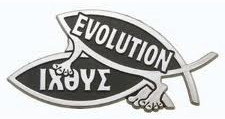
Photo credit: EvolveFish
Related links:

  • “Survival of the fittest,” Wikipedia.
  • Michael Le Page, “Evolution myths: ‘Survival of the fittest’ justifies ‘everyone for themselves,’” NewScientist, 4/16/08.

The Moon Isn’t Made of Green Cheese … Is It?

A moon made of cheese is cut, and a wedge is pulled awayEaster has recently passed, and I’d like to rerun a post on the resurrection.
In a fable going back centuries within various cultures, a simpleton sees the reflection of the full moon in water and imagines that it’s a wheel of green (that is, young) cheese. It’s a tale that we often pass on to our children and that we discard with time, like belief in the Easter Bunny.
But how do you know that the moon isn’t made of green cheese?
Physicist Sean M. Carroll addressed this question recently. After a few moments exploring physical issues like the moon’s mass, volume, and density and the (dissimilar) density of cheese, he gave this frank broadside:

The answer is that it’s absurd to think the moon is made of green cheese.

He goes on to say that we understand how the planets were formed and how the solar system works. There simply is no reason to suppose that the moon is made of green cheese and plenty of reasons to suppose that it’s not.

This is not a proof, there is no metaphysical proof, like you can prove a statement in logic or math that the moon is not made of green cheese. But science nevertheless passes judgments on claims based on how well they fit in with the rest of our theoretical understanding.

Bringing this thinking into the domain of this blog, how do we know that Jesus wasn’t raised from the dead? The answer is the same: it’s absurd to think that Jesus was raised from the dead.

  • We know how death works. We see it in plants and animals, and we know that when they’re gone, they’re just gone. Rats don’t have souls. Zebras don’t go to heaven. There’s no reason to suppose that it works any differently for our favorite animal, Homo sapiens, and plenty of reasons to suppose that it works the same.
  • We know about ancient manuscripts. Lots of cultures wrote their ancient myths, and many of these are older than the books of the Old Testament: Gilgamesh (Sumerian), Enûma Eliš (Babylonian), Ramayana (Hindu), Iliad (Greek), Beowulf (Anglo-Saxon), Popol Vuh (Mayan), and so on. For whatever reason, people write miracle stories, and we have a large and well-populated bin labeled “Mythology” in which to put stories like those in the Bible.
  • We know about how stories and legends grow with time. We may have heard of Charles Darwin’s deathbed conversion to Christianity (false). Or that a decent fraction of Americans thought that President Obama is a Muslim. Or that aliens crash-landed in Roswell, New Mexico. Or that a new star appeared in the night sky with the birth of North Korea’s Kim Jong Il. In our own time, urban legends so neatly fit a standard pattern, that simple rules help identify them.
  • We know that humans invent religions. There are 42,000 denominations of Christianity alone, for example, and uncountably many versions of the myriad religions invented through history.

Natural explanations are sufficient to explain Christianity.
Might the moon actually be made of cheese? Science doesn’t make unconditional statements, but we can assume the contrary with about as much confidence as we have in any scientific statement.
Might Jesus have been raised from the dead? Sure, it’s possible, but that’s not where the facts point. Aside from satisfying a preconception, why imagine that this is the case?
Photo credit: TV Tropes
Related posts:

Women at the Tomb? Weak Evidence for the Resurrection.

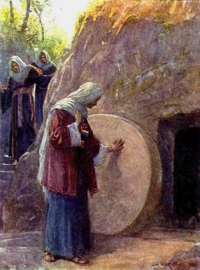
The women at the empty tomb isn't much evidence that Jesus was divineLet’s consider an incident from that first supposed Easter. All four gospels say that women were the first to discover the empty tomb. (Of course, who was actually at the tomb varies by the gospels, as do many other important details about the resurrection, which makes the gospels unreliable as history. But let’s ignore that for now.)
Many apologists point to the women as an important fact arguing that the gospels are reliable. Greg Koukl says:

Women, disrespected in the ancient world, are the first to witness the risen Christ. Why include these unflattering details if the Gospels are works of fiction?

I don’t know who argues that the gospels are fiction. I don’t think they’re history, but I certainly don’t think that they were deliberately invented. But let’s set that aside as well.
William Lane Craig says:

The discovery of the tomb by women is highly probable. Given the low status of women in Jewish society and their lack of qualification to serve as legal witnesses, the most plausible explanation … why women and not the male disciples were made discoverers of the empty tomb is that the women were in fact the ones who made this discovery.

That is, having women make this momentous discovery is embarrassing.
This is an application of the Criterion of Embarrassment, which argues that you’re likelier to delete something embarrassing than add it to your story. And if a story element is embarrassing, that points to its being historical fact.
But what’s embarrassing? Things that look embarrassing to us may not have been so to the author. For example, all four gospels show Peter denying Jesus three times. That’s pretty embarrassing … or is it?
Paul’s relaxed approach in converting Gentiles conflicted with the more traditional approach of Peter and James (the conflict is shown in Galatians 2:11–21, where Peter is called “Cephas”). Maybe supporters of Paul built their case by circulating a story in which Peter looks foolish, and this story became part of the canon.
So our question becomes: is it embarrassing to have women discover the empty tomb? These apologists certainly think so, and historical records agree on women’s unreliability. Josephus, a first-century historian, stated, “Let not the testimony of women be admitted because of the levity and boldness of their sex,” and the Mishnah (a Jewish legal text written in 220 CE) concurs.
However, this flimsy argument is much more popular than it deserves to be. I’ll respond in several ways.
Give the original authors credit for being good storytellers. As plot twists go, having women make the discovery instead of men isn’t particularly shocking. But if you find it a powerful argument for the truth of the story, then you can imagine why that element might have become attached to the story.
The gospel story wasn’t made up. The point that women were unreliable witnesses is relevant only in rebutting the charge that the story was deliberately invented, a claim I don’t make. I’ve never heard this hypothesis except by apologists. Instead, what best fits the facts for me is that the story documented in the gospels (in incompatible versions, but that’s another story) is the result of forty or more years of oral history. Each gospel is a snapshot of the tradition of a different church community in widely different places (perhaps Alexandria, Damascus, or Rome?) and over decades of time.
Believers might demand, “Well, how do you explain the empty tomb?” But of course, that assumes the accuracy of the gospel story to that point. It’s like saying, “How do you explain Jack’s cutting down the beanstalk any other way than that there really was a giant climbing down after him?”
Who cares about women’s “unreliability”? Women discover the empty tomb, they tell men, the men verify the story, and then the men spread the word. If you don’t like women as witnesses, you’ve got the men.
That women were less reliable as witnesses in court doesn’t matter because there is no court in the story! The women were trustworthy where it mattered—in conveying the story to people who knew and trusted them.
Tending to the dead was women’s work in this culture. Instead of women discovering that Jesus had risen, imagine this incident:

On the first day of the week, at early dawn, Simon Peter and James entered the kitchen to prepare bread for the community. In the darkness of the kitchen, a voice called out to them saying, “Why do you tend to minor matters when there is the LORD’s work to be done?” And they took hold of His feet and worshiped Him.

What’s wrong with this story? It’s that preparing bread is women’s work in this culture. It makes no sense to have men come across Jesus in the kitchen. And the same is true for men dealing with the dead. According to the Women in the Bible web site:

It was the women’s task to prepare a dead body for burial. … Tombs were visited and watched for three days by family members. On the third day after death, the body was examined. … On these occasions, the body would be treated by the women of the family with oils and perfumes. The women’s visit to the tombs of Jesus and Lazarus are connected with this ritual.

The Bible also gives clues to women’s role in mourning in Jer. 9:17–20 and 2 Sam. 14:2.
Mark focuses on reversals, and the other gospels followed Mark’s lead. Richard Carrier gives a detailed discussion of this topic and argues that a the-last-shall-be-first philosophy led Mark to add this touch.

Given Mark’s narrative agenda, regardless of the actual facts, the tomb has to be empty, in order to confound the expectations of the reader, just as a foreign Simon must carry the cross instead of Peter, a Gentile must acknowledge Christ’s divinity instead of the Jews, a Sanhedrist must bury the body, and women must be the first to hear the Good News.

He continues with a fascinating hypothesis about the relevance of the names of the three women that Mark places at the empty tomb. You can read the argument and decide for yourself if it’s well founded.
Seeing the gospel story as no more supernatural than any other myth from the past best explains the facts.
Photo credit
Related links:

Back from the Reason Rally

Atheism clashes with Christianity

I’ve recently returned from the Reason Rally, held on the National Mall in Washington D.C. (photos here). There were an estimated 20,000 people there, in the rain, which is a lot more than I would have predicted. The organizers figured that it was the biggest secular gathering in world history by a factor of ten.
The atheist glitterati were all there—Michael Shermer, James Randi (founder of The Amazing Meeting), Richard Dawkins, Greta Christina (my favorite atheist blogger), PZ Myers, Tim Minchin (whose beat poem “Storm” is awesome), Eddie Izzard, Jessica Ahlquist (American Atheist’s “Atheist of the year” for her lawsuit against the religious banner in her public high school), Rep. Pete Stark (the only open atheist in Congress), Sen. Tom Harkin (not an atheist [!] but a senator who welcomed us anyway), Penn Jillette, Todd Stiefel (whose foundation helped sponsor the event), Nate Phelps (an eloquent and estranged member of the infamous Phelps family), and many more. The Rally proceeded without a break for over seven hours.
The 2012 American Atheist conference was the following two days and had 1300 attendees. The theme this year was “Come Out,” and many speakers talked about both the need for that and for dealing with the challenges that coming out as an atheist can impose on someone living in America today.
After being away from the office, I’ve got a lot to catch up on, and I’ll be busy with the Northwest Freethought Alliance conference here in Seattle this weekend. I’ll get back to a regular posting schedule soon. Thanks for all your comments to the posts of the past couple of weeks; I’ll be responding ASAP.
Any brief summary will be inadequate to cover the Rally and conference. I’ll just summarize some of the highlights.

  • Roughly ten Christian protesters held signs at the Rally. Discussing apologetics with Christian sign carriers is one of my hobbies, but each was surrounded by lots of atheists—sometimes conversing thoughtfully and sometimes haranguing. The only one that I talked to at length admitted that he had no arguments in favor of Christianity but was just mindlessly on the Mall, witnessing for Jesus. I wondered what the point was, since he’s not informing anyone of anything. He had no new arguments, and simply stating the tenets of Christianity (all he seemed capable of doing) to atheists better informed than the average Christian was pointless.
  • Taslima Nasrin from Bangladesh spoke of the Muslim response to her writings—riots, burned cars, and house arrest. After hearing this, it was hard to compare any struggle atheists might have in coming out with hers.
  • Physicist Lawrence Krauss said that philosophers asking “Why is there something rather than nothing?” is like Johannes Kepler asking “Why are there five planets?” It’s an irrelevant and outdated question!
  • Too often, the Christian says, “Morality is built on a foundation of God’s existence!” and the atheist response is a tepid, “But we are moral, too.” We need to take morality back. Our morality is superior—it’s built on something besides myth and wishful thinking.
  • Richard Dawkins spoke of a poll his foundation did in the UK. Of self-identified “Christians,” many accepted non-Christian beliefs (ghosts, fate, reincarnation), many don’t believe in the power of prayer, many don’t read the Bible and know very little about it, and some don’t even believe that Jesus was a historical figure. Conclusions: most “Christians” aren’t, and we shouldn’t accept Christians’ self-identification but rather ask what they mean.

Asked why they had been recorded as Christian in the 2011 Census, only three in ten (31%) said it was because they genuinely try to follow the Christian religion, with four in ten (41%) saying it was because they try to be a good person and associate that with Christianity.
But when asked where they seek most guidance in questions of right and wrong, only one in ten (10%) said it was from religious teachings or beliefs, with over half (54%) preferring to draw on their own inner moral sense.

  • Jerry DeWitt is a cheerful ex-pastor who left religion half a year ago through the Clergy Project, a group trying to find a soft landing for doubting pastors. I’ve written before about Rich Lyons, a local ex-pastor who had to get through the process solo and suffered from PTSD after leaving his pulpit.
  • PZ Myers gave an interesting quote from Sean Carroll: “The reason why science and religion are actually incompatible is that, in the real world, they reach incompatible conclusions.”
  • PZ Myers on trying to juggle science and religion: “Squatting in between those on the side of reason and evidence and those worshipping superstition and myth is not a better place. It just means you’re halfway to crazy town.”
  • Religion is a natural part of the human mind. Okay, and smallpox is natural, too. That doesn’t mean you resign yourself to it.
  • This chart from a 2009 Gallup poll documents the long-term change in religious preference in the U.S. and shows that the increase in atheism and erosion in Christianity has been fairly steady and not just a recent phenomenon.
  • In a cartoon, two guys are talking. One says, “New Atheism indeed—it’s just the same old indisputable scientific evidence again.”
  • Religion makes you happy? Okay, but so does a puppy. There’s no need to abandon reason for happiness.
  • On the subject of atheist accommodationists (“Do you have to be so shrill?”) versus confrontationists (“Don’t mince words—tell it like it is!”), Greta Christina likened the atheist movement to a toolbox. If you’re a hammer, be the best hammer you can be and let the other tools be the best they can be.
  • Christina drew parallels with the gay movement and noted that for many straight people, simply knowing a gay person was key to dismantling their prejudices. Similarly, we need to come out (where practical) to help Christian America dismantle its anti-atheist prejudices. One important difference: when you come out as gay, you’re not telling straight people that they’re wrong. That’s not really true with atheism.
  • The Secular Student Alliance has grown from 50 chapters in 2007 to 250 a year ago and even more today. The Campus Crusade for Christ (now “Cru”) has three times as many chapters, but it has an annual budget of half a billion dollars and is losing chapters.

Curiously, no one talked about what I like to talk about: critique of Christian apologetics. I’m not sure what to make of this. Does no one care about this topic? Has everyone already moved on, comfortable in their conclusion that the emperor has no clothes?
Ah well, I guess I’ll just be the best hammer I can be.

How can you have judgment if you don’t have faith
and how can I trust you with power if you don’t pray?
Newt Gingrich (October, 2011)