
I Never Thought About it That Way …

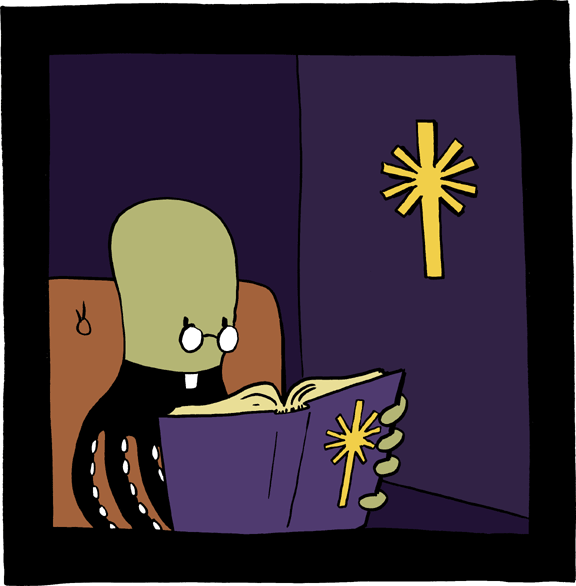
Photo credit: Saturday Morning Breakfast Cereal
 I’ll be leaving soon for a bit of vacation and then I’ll attend the Reason Rally in Washington D.C. on March 24, “the largest gathering of the secular movement in world history.”
After that, it’s the American Atheists National Convention (March 25–6), also in Washington.
 If you’re attending too, I hope to bump into you. Say hello if you see me.
And if you’re in the Seattle area, the Northwest Freethought Conference featuring Richard Dawkins as keynote speaker will be held March 31–April 1.
I have blog posts queued up for the next couple of weeks while I’m gone, so come back often, but I won’t be able to respond to comments very well.
I’m looking forward to telling you about it when I return!
Faith is superstition disguised as virtue
— Pat Condell
 The Trojan War of roughly 1200 BCE and the destruction of the city of Troy, about which Homer wrote the epic Iliad, was monumental enough in itself, but that period also marked the end of the Mycenaean Greek civilization. The Linear B writing system of the time was abandoned, never to be revived, and most of Greek cities of the time were destroyed or abandoned. Only after centuries of relative barbarism did the Greek city-states of Sparta, Corinth, Athens, and so on appear.
The Hittite empire in Anatolia (modern-day Turkey) also collapsed at the same time. So did the New Kingdom in Egypt.
Experts speculate on many possible causes of this Bronze Age Collapse—a meteor, drought, the eruption of an Icelandic volcano that caused climate change, the spread of iron weapons, and other causes. Certainly invasion was a factor, but does this explain everything or were these just opportunistic invasions after the existing empires were weakened? The cause(s) are still disputed and none explains all the facts.
Like a global extinction event that opens up niches for new species to invade, this collapse allowed new civilizations, technologies, and writing systems to emerge.
What happened to Israel, in the middle of these collapsing empires? The historical record is unclear—the traditional date for the Israelite conquest of Canaan had been about 1400 BCE, but the modern consensus is 1250. Perhaps the Bronze Age Collapse was a factor in jump-starting Jewish civilization. If nothing else, this setback for the nearby empires must’ve provided some breathing room for the people in the Levant.
Photo credit: Wikimedia
Related posts:
Related links:
 Sandy beaches often have a line of debris left by the last high tide. These lines look different on different beaches, reflections of the local environment. They might contain rocks, shells, seaweed, jellyfish, flotsam or garbage, egg cases from skate or conch, and so on.
When I was about 11, I spent a week at a beach on which amber occasionally washed up. After a little training, I got pretty good at seeing the amber. On a different beach, the prize was fossilized shark’s teeth, and again I got good at spotting them amid the pebbles.
Given a little training and motivation, the mind pulls out interesting things from the background chaos. What is the wheat and what is the chaff changes based on your needs.
Suppose you’re an emergency room nurse and comment on what a crazy night it’s been and a coworker says, “That’s always the way it is with a full moon.” Now that your mind has been primed, you may notice this coincidence often. But seeing this as more than just a coincidence without good evidence is confirmation bias. Confirmation bias becomes a problem when you sift through the evidence that you come across and select only those bits that confirm what you already believe. You don’t seek information but confirmation.
The hypothesis “God answers prayers” can also be supported by confirmation bias—those prayers that more or less come true within some broad time range are counted as successes, and those that don’t are either ignored or repositioned with, “Sometimes, God says no.” Psychics and horoscope watchers will similarly list successful predictions and ignore or forget the failures.
I listened to the weekly Reasons to Believe podcast from Creationist Hugh Ross for a while. It was little more than a selection of the few bits of evidence from the thousands of scientific articles that week that could be interpreted to support his old-earth Creationist views. Seeing this for what it is—an answer to the question, “What in this week’s news would support my Creationist preconceptions?”—would be fine. It’s when we imagine that this is objective science that we delude ourselves.
So that we evolution-accepting atheists don’t get too smug, Sam Harris proposed the Fireplace Delusion, a chance to have our own preconceptions challenged. It’s a good exercise by which to see your mind being offended and the defenses it puts up to maintain its initial position.
The mind is built to favor evidence that confirms an existing opinion over disconfirming evidence, and to combat this bias, science tries to disconfirm theories rather than confirm them. You can’t prove a scientific theory right, but you can prove it wrong. This reversal—testing our opinions with disconfirming challenges rather than selecting confirming evidence—is a good example to follow.
We can prime our mind, like we’re looking for shark’s teeth on the beach, to pull in only what we want to see, but we delude ourselves when we do so.
Photo credit: Wikimedia
Related posts:
Related links:
 2012 is the centennial year of the birth of Alan Turing, a British cryptanalyst central to the project that decoded German Enigma messages during World War II and a pioneer in computer science. Celebrations marking the event are planned, and the UK has issued an Alan Turing stamp.
Though you may not have heard of Turing, you have been touched by his work. When a web form challenges you to read distorted text to make sure you’re not a computer program, you’re participating in a variant of the Turing Test. When you use a modern PC, you’re using a Turing Machine.
Turing was convicted under an 1885 law against homosexuality and forced to undergo “chemical castration” by hormone treatments. Details of his death are imprecise, but, despondent over the treatments, he apparently killed himself by cyanide poisoning.
This brilliant gay man was 41.
Gay suicides continue in our own day. A 14-year-old boy killed himself last September in response to school bullying, just months after recording an “It Gets Better” video.
For those who wish for a day when sexual preference is as bothersome as hair color, things are improving. Within the last month, Washington and Maryland enacted laws allowing same-sex marriage (though both laws will likely be challenged by referendums in November), bringing to eight the number of states with such laws. The military’s Don’t Ask, Don’t Tell policy was repealed last fall. A Pew Research poll shows that supporters of same-sex marriage in the U.S. have recently become greater in number than those who oppose it. Archie Comics has even become gay friendly.
Can someone explain to me why same-sex marriage is an issue? I don’t get it, and I’ve drunk the marriage Kool-Aid. My wife and I have been married for over 30 years. I got married the same week I graduated from college. Two kids, no divorce, no adultery. When a preacher or politician imagines himself speaking to the country on this issue, he puts me in the front row. And I’m still waiting to hear a coherent argument for why same-sex marriage should bother me.
One of the most popular arguments is that this would redefine marriage. Okay, but so what? The definition of marriage hasn’t been a constant in the U.S. Until Loving v. Virginia in 1967, marriage in 17 states meant the union of one man and one woman of the same race. As I discussed in a previous post, the original 1959 conviction that prompted this landmark Supreme Court case was backed up with Christian justification.
Before that, marriage was redefined in 1890 to prohibit polygamy. In that case, the Supreme Court made clear how a clash between religious precepts and the laws of the state is resolved:
However free the exercise of religion may be, it must be subordinate to the criminal laws of the country.
And the definition of marriage continues to be a moving target since not all states have the same rules. Can you marry without parental approval at age 18? Yes in most states; no in Mississippi, where you must be 21. Is common law marriage recognized? Yes for Alabama and Colorado; no for Alaska and Delaware.
The definition or marriage hasn’t even been constant within Christianity—the stories of Abraham, Jacob, David, Solomon and other patriarchs make clear that the biblical definition of marriage was the union of one man and one or more women.
Marriage evolves, and if anything is attacking marriage today, it’s not same-sex marriage but divorce. Indeed, it’s odd that at a time when many Christian leaders are lamenting marriage’s reduced status within society, it dismisses a group that wants to embrace it. There’s no fixed pie here, where you getting a bigger slice means I get a smaller one.
What’s behind this? Is it the church’s obsession with sex? Perhaps it fears sex as a powerful competitive force. This reminds me of the Soviet Union suppressing Christianity because it was a powerful competitive force.
Actor and author Stephen Fry, in talking about the church and sex, likened sex to food. He said, “The only people who are obsessed with food are anorexics and the morbidly obese. And that, in erotic terms, is the [Christian] church.”
Let’s visit one elephant in the room that may be behind Christians’ objection to homosexuality. Gay sex, to use clinical terminology, is icky. My response: yes it is. And I have a quick and effective solution. If you don’t like gay sex, don’t have any. It’s really pretty easy when you think about it.
But this sidesteps the bigger issue. It’s not that gay sex is icky. It’s that sex is icky.
Imagine you’ve just met someone at a party, and he soon turns the conversation to his particular sexual turn-ons. You’d probably find the conversation very uncomfortable.
Another example: explain in detail the mechanics of sex to a six-year-old. The child would be disgusted whether you describe gay or straight sex. Sex is disgusting; it’s just that we are drawn to our preferred brand of sex because the passion overrides the disgust. We typically don’t have the passion to override the disgust from our inner six-year-old for other brands.
When I read a diatribe against homosexuality or same-sex marriage written by some politician or pastor, I wonder: with all the problems in the world—disease, poverty, famine, natural disasters, the economy, and so on—this is near the top of your list of things that keep you up at night? Seriously? You can’t find something else to worry about? Sorry, but same-sex marriage doesn’t affect my marriage—or yours—one bit.
There’s far too little love in the world as it is. It’s unthinkable—nay, reprehensible—to stand in the way of what love can be found.
Photo credit: San Diego Shooter
Related posts:
Related links:

