About Bob Seidensticker

I'm an atheist, and I like to discuss Christian apologetics.

Word of the Day: Hyperactive Agency Detection

Does God exist?  I doubt it.February 12 is Darwin Day, the birthday of Charles Darwin. In honor of Darwin’s 203rd birthday, let’s look into a term that’s related to both evolution and religion.
Imagine an early hominid in the grasslands of Africa. He hears a rustling in the bushes—is that a cheetah or just the wind? Should he run away or ignore it?
There are two kinds of errors. Suppose our friend thinks it’s a cheetah and runs away … but he’s wrong. This is a false positive. He’s crying wolf. There can be a cost to this—our timid hominid might have been frightened away from a water hole.
But consider the other error. The hominid might think it’s the wind in the tall grass … but he’s wrong. This is a false negative. The cost is obvious—he likely becomes a predator’s lunch.
Given the disproportionate consequences for guessing wrongly, natural selection seems to have selected for caution. As a result, early man may have developed a “hyperactive agency detection device”—an overactive tendency to see agency (that is, intelligence) in nature, even where there is none. The HADD may also be where we detect patterns in things—superstition, concluding that odd events are more than coincidence, or even conspiracy theories.
If this gave early man the ideas of spirits of the dead and gods, this may help explain where early religion came from.
Photo credit: Simon Varwell
Related posts:

Related links:

Biblical Analysis of the Super Bowl

Christianity and atheism discussion and Does God exist?Everyone’s familiar with Tim Tebow’s public thanks to God for his football success and his love of the Bible verse John 3:16: “For God so loved the world that he gave his one and only Son, that whoever believes in him shall not perish but have eternal life.”
Many of us have heard some of the spooky 3:16 connections with Tebow’s next-to-last game this season. The Broncos beat the Steelers on January 8 in Tebow’s first NFL playoff game, with Tebow throwing for 316 yards. This was three years to the day that Tebow made a public splash wearing eye black that read “John 3:16” in the BCS Championship game. In the win against the Steelers, Tebow averaged 31.6 yards for each pass completion, an NFL record for postseason games.
Let’s do the same kind of analysis on Eli Manning’s Super Bowl win on Sunday. He threw a total of 296 yards.
There is no book in the Bible with the verse 2:96, so the significance must instead be in verse 29:6. Several books have this verse.

Put the turban on his head and attach the sacred emblem to the turban. (Ex. 29:6)

Maybe this represents Manning being declared the game’s MVP.

My path was drenched with cream and the rock poured out for me streams of olive oil. (Job 29:6)

This may represent the accolades he received after the game.

The LORD Almighty will come with thunder and earthquake and great noise, with windstorm and tempest and flames of a devouring fire. (Isaiah 29:6)

That’s more like it—some godly justice! God is obviously furious with the results of the game. I’ll bet he was a Patriots fan.
That’s a big claim appropriate for the year’s biggest game.
Still, I wondered if there was more. I realized my error when I converted yards into the biblical measure of cubits. There’s a bit of fuzziness in the definition of the cubit, and 296 yards becomes something in the range 511 to 518 cubits. Since Tebow’s quote is from the New Testament, let’s look there for verses in the range 5:11–18.
Mark 5:11–18 is the story of demons cast from a possessed man into 2000 pigs. In Luke, it’s the story of Jesus healing leprosy. In John, Jesus gets into trouble with the Jewish leaders because he heals on the Sabbath. James and 1 John both state that prayer heals sick people, and they make a causal connection between sin and sickness.
The message starts to take shape—something about mental and physical illness being caused by sin and demons.
The breakthrough came when I went back to the quarterback’s name—Eli Manning. That’s Elisha Manning. Of course—the Old Testament prophet Elisha! it wasn’t the New Testament but the Old Testament that had the clue. And there it was, in 2 Kings 5:11–18, the story of Naaman, a general from Aram (today’s central Syria), who had leprosy.
Naaman had heard of the power of the Yahweh and came to Israel for healing. Elisha commanded him to wash seven times in the Jordan. Naaman had expected some ordeal or fee and considered this a snub, but his servants persuaded him to give it a try, and sure enough, his leprosy was cured. Naaman realized the power of Yahweh and asked forgiveness when he would be obliged to bow before Rimmon (Baal) back in Syria. Elisha granted it, saying “Go in peace.”
The scales fell from my eyes. God’s message in this Super Bowl is that he can cure leprosy. Leprosy is now reliably treated with antibiotics, of course, so this isn’t especially relevant, but it’s good to know that God’s still concerned about diseases that have little or no impact on society today.
I know what Christian apologists will say about my analysis. They’ll say that this is arbitrary, that I’m just picking and choosing verses based on what I want to find, collecting ridiculous passages and ignoring the rest. They’ll say that the chapter and verse divisions are not divinely inspired, with the New Testament being divided into verses only in the 1500s. They’ll say that this entire analysis is nonsense, built on nothing solid.
And to that I say …
Busted! You got me. That’s exactly what I was doing. I was indeed picking verses with an agenda.
But then if it’s nonsense when I do it, why is it any more meaningful when Christians do it?
Photo credit: Catholic Online

Word of the Day: Burqa, Niqab, Hijab

A novel that tackles Christian apologeticsHijab is the Muslim dress code for women. It is typically interpreted to permit only the hands and face to be visible in public. It also refers to the headscarf that covers the head but not the face.
The niqab is a cloth that covers the face. It can reveal the eyes or have a mesh or veil that covers the eyes. Seeing through the veil is reportedly no more difficult than seeing through sunglasses.
The burqa is a loose-fitting outer garment that covers the body and includes both the niqab face covering and hijab head covering. The hands and face are often treated together, with customs saying either that they may both be visible or must both be covered. In the latter case, women often wear gloves.
The Arab world has many local customs, of course, and there are many variations. For example, the chador is an Iranian cloak without fasteners that is held closed in front.
Demands on men are minimal by comparison, often interpreted to require covering the knees and avoiding jewelry.
France banned “ostentatious religious symbols” like the hijab from public schools in 2004. Nicolas Sarkozy (then a French minister) justified it this way: “When I enter a mosque, I remove my shoes. When a Muslim girl enters school, she must remove her veil.” Turkey also prohibits the hijab in schools and universities. The French law was extended in 2010 to ban face covering in public, including the niqab.
A Muslim-American woman is the second-best saber fencer in the U.S. and is hoping to represent the U.S. in the 2012 Olympics, even though it will fall in Ramadan, the month when she will be prohibited from eating or drinking during the day. She conforms to hijab and was attracted to the sport because the uniform (inadvertently) also conforms to hijab.
From a Western standpoint, it’s easy to see the hijab requirement as oppressive, though from the inside it can be seen as a matter of cultural identity. A cultural demand doesn’t always vanish when that demand is lifted. During the Qing dynasty (1644–1912), Manchu rulers imposed queues (long ponytail with an otherwise shaved head) on Chinese men. Not wearing one was considered disloyal and a capital crime, but when the dynasty ended, many men still wore the queue as a custom.
A fascinating example of unexpected consequences came when wearing the veil became mandatory in Iran after the 1979 revolution. Protest came from an unexpected quarter—women who had been wearing the veil. Before, they could publicly say, “God is great” by wearing the veil in public. After, they were simply obeying the law.
Imagine a Christian theocracy in the West that made wearing crosses mandatory. The same thing would happen to the cross as happened to the Iranian veil—the cross would no longer be a religious statement but a political one.
I wonder if there’s something of this kind of unexpected consequence with Christian morality. Do Christians do good things just because they’re the right thing to do? That is, do they do good things for the same reasons that atheists do them? Or do they do them because God is watching? Whether God is tallying up good and bad actions that will confront the Christian in heaven or the Christian is simply trying to put a smile on God’s face, I wonder if the Christian moral motivation is shallower than that of the atheist.
Related links:

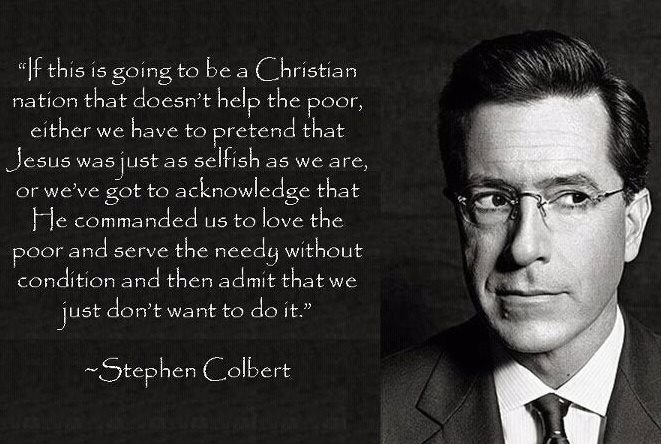
Does the Christian Care About the Poor or Not?

A novel about Christian apologetics and atheist counter-apologetics
The New Testament is brimming with demands that the Christian care for the poor and needy.  Think of the parable of the Sheep and the Goats (Matt. 25:31–46), the parable of the Good Samaritan (Luke 10:25–37), or the story of Jesus and the rich young man (Luke 18:18–30).
How some politicians and religious leaders can juggle the hypocrisy is beyond me.  I’ll grant that the Bible can be picked apart and made to say just about anything, but isn’t charity a prime demand?

[Jesus said:] Go, sell everything you have and give to the poor, and you will have treasure in heaven. Then come, follow me. (Mark 10:21)
[John the Baptist said:] Anyone who has two coats should share with the one who has none, and anyone who has food should do the same. (Luke 3:11)
If anyone has material possessions and sees a brother or sister in need but has no pity on them, how can the love of God be in that person? Dear children, let us not love with words or speech but with actions and in truth. (1 John 3:17–18)
Religion that God our Father accepts as pure and faultless is this: to look after orphans and widows in their distress and to keep oneself from being polluted by the world. (James 1:27)

Word of the Day: Irreducible Complexity

A novel about Christian apologetics and atheismMicrobiologist Michael Behe coined the term “irreducible complexity” to describe a system in which every part is mandatory. Here is his definition:

By irreducibly complex I mean a single system composed of several well-matched, interacting parts that contribute to the basic function, wherein the removal of any one of the parts causes the system to effectively cease functioning.1

Let’s look at a popular example, the remarkable bacterial flagellum. Built of several dozen different proteins, this tiny motor with a whip-like appendage can propel a bacterium 60 cell lengths per second. Compare this to the cheetah, the fastest land animal, which sprints at 25 body lengths per second. (Here’s a good agenda-less video showing the structure of the flagellum.)
The irreducible complexity claim is this: imagine turning the clock of evolution back. Which protein was the last to be put in place? Remove any protein from the flagellum and it doesn’t function. So if one step back in time from the working flagellum was something useless, no matter which protein you remove, why would evolution have created this thing? Evolution doesn’t spend effort slowly building elaborate nonfunctioning appendages on the remote chance that with a few more mutations over 100,000 generations it might get lucky and create something useful. But Intelligent Design comes to the rescue by postulating a Designer that put everything together all at once.
We can topple this thinking by considering an arch. Which was the last stone to be put in place in an arch? If you try to turn the clock back by removing the central keystone, the arch falls. So that one couldn’t have been last. But try removing any stone from the arch and the same thing happens. This makes the arch irreducibly complex, using this Intelligent Design thinking, with a Designer levitating the stones into place all at once as the only explanation.
But of course this is nonsense. If you imagine watching a movie of the building of an arch played backwards, the first change you’d see was not a stone removed but the last piece of scaffolding put into place. Then the remainder of the scaffolding to support the stones, then the stones removed one at a time, and then the scaffolding removed.
In the same way, the step that preceded the bacterial flagellum might have been the removal of an unnecessary piece of scaffolding.
There is much more to say about why the idea of irreducible complexity has not won over the science of biology, including attacks on how good an example the flagellum is of irreducible complexity, but that is a tangent for this post. For more on this topic, check out the links below.
Science may well have unanswered questions regarding the origin of the flagellum, but “I don’t know” is no reason to invent a Designer. And you can be sure that once the origin of the bacterial flagellum is sufficiently well understood, this argument will be discarded like a used tissue and some other complex feature of biology (and there’s always something) will be seized upon by the Intelligent Design advocate as the wooden stake that will finally destroy the monster that is evolution.
If the past is any indication, our ID friend will have a very long wait.
1 Michael J. Behe, Darwin’s Black Box (Touchstone, 1996), p. 39.
Photo credit: harrymoon
Related posts:

Related links:

16 Arguments Against Abortion, with Rebuttals (Part 2)

Atheism and Christianity discussionHere are the remaining arguments against abortion, with rebuttals. See part 1 here.
10. Why is murder wrong? Because it takes away a future like mine. If we found intelligent humanoids like us on another planet, killing them for sport would be wrong for this reason. And this is why abortion is wrong—it takes away a future like mine. This is Glenn Peoples’ Argument from the Future (podcast episode #29, 8/3/09).
Why focus on the future? Assuming these humanoids are largely unchanging month to month, like people, killing them for sport takes away a present like mine. I assume that Peoples focuses on the future only because he has no argument otherwise.
But let’s take the path that Peoples points us to. Killing a fetus would deprive it of a future like mine, but so would killing a single skin cell, once they are clonable into humans. Would it then a crime to scratch your skin? Or, let’s take it further back. Suppose I have two kids. Was it criminal to not have three? Or four? Or fifteen? I’ve deprived those people-to-be of life.
Extrapolating back to the twinkle in my eye, saying that we have a person deserving of life at every step is ridiculous. But the facts fit neatly and logically into the spectrum argument.
11. But a fetus has a soul! Does it? If the zygote has a soul and then it splits into twins, does each twin have half a soul or do they get another one as needed or did they get two to begin with? What about conjoined twins? Do they share a single soul like a shared body part? What about babies with terrible birth defects that leave them with very little brain function? What about a person cloned from a cell—would they have a soul? And if the story for the soul has a happy ending for the 50% of pregnancies that end in spontaneous (natural) abortion, why not for an artificial abortion?
This mess vanishes if we don’t insist on a soul. As Daniel Dennett said, “What isn’t there doesn’t have to be explained.”
12. “Abortion is much more serious than killing an adult. An adult may or may not be an innocent, but an unborn child is most definitely innocent.” These are the words of an archbishop from Brazil. He was outraged at the abortion done on a nine-year-old girl, raped and impregnated by her stepfather. In response to the abortion, the church excommunicated the family of the girl and the doctors who performed the abortion.
Wow. Let’s leave this example of how religion makes you do crazy things and focus on the claim. First, a fetus is not a child. Second, the spectrum argument defeats this claim.
Variations on this argument are popular, and they all have pretty much the same response. Here are a few.
12a. Abortion kills a human life (at the bottom of Maslow’s hierarchy) to help with another human’s self-actualization (higher on the hierarchy). That’s the opposite of the way it’s supposed to work. The two “human lives” are not comparable. This ignores the spectrum of development from single cell to trillion-cell newborn.
Killing a blastocyst with fewer cells than the brain of the fly troubles me less than killing a civilian in another country due to war or killing a criminal on death row.
12b. Don’t we normally go out of our way to defend the defenseless? Again, this ignores the spectrum. Defenseless people are more important than defenseless cells.
12c. Haven’t we been through this with racial minorities? Declaring that single cells aren’t human is like declaring that African-Americans aren’t human. Nice try. Spectrum argument.
12d. In response to your abortion clinic example: you argue that, if given a choice between saving a child and ten frozen embryos, you’d save the child. Okay, and if given the choice between your wife and a stranger, you’d save your wife, but that doesn’t mean that you can kill strangers. Spectrum argument.
13. Haven’t you heard of adoption? That’s the answer to an unplanned pregnancy. No, it’s clearly not the answer. Two percent of all births to unmarried women in the U.S. are placed for adoption. “Just have the baby and release it for adoption” is a pat on the head. It might make you feel good, but it doesn’t work.
14. You say that a trillion cells is definitely a person. Okay, how about a trillion minus one—is that a person? And if so, how about a trillion minus two? And so on. This same game could be played with the blue/green spectrum. If this color is “green,” what about just a touch more blue—isn’t that green as well? The point remains that the two ends of the spectrum are very different—green is not blue! Similarly, a single cell is not a newborn with arms, legs, kidneys, brain, and so on.
15. The woman who got pregnant knew what she was doing. Let’s encourage people to take responsibility for their actions. She didn’t necessarily know what she was doing—sex education is so poor that many teens become sexually mature without understanding what causes what.
But let’s assume that the woman knew what she was doing and was careless or stupid. What do we do with this? When someone shoots himself accidentally, that was stupid, but we all pay for the medical and insurance system that puts them back together. Let’s educate people, demand responsibility, and have a harm-reduction approach where we find the best resolution of problem. For a woman whose life would be overturned with a pregnancy, that resolution might be abortion.
16. If you’re so smart, where do you draw the line? I don’t. I find that pro-life advocates quickly turn the conversation to the definition of the OK/not-OK line for abortion, hoping to find something to criticize. I avoid this, both because it diverts attention from the spectrum argument—the main point I want to make—and because I have no opinion about the line and am happy to leave it up to the experts.
Barack Obama answered that question, “That’s above my pay grade,” which satisfies me, since he was running for Commander-in-chief, not Obstetrician-in-chief.
Next time: 5 Recommendations to the Pro-Life Movement
Photo credit
Related posts:

Related links: