About Bob Seidensticker

I'm an atheist, and I like to discuss Christian apologetics.

Word of the Day: Theory and Law

A novel of Christian apologeticsLet’s start with a few definitions within mathematics and logic. An axiom or postulate is a proposition (statement) taken as a given. A lemma is an intermediate proposition or stepping stone rather than the final result, which is a theorem. A corollary follows readily from a theorem—it’s often simply another way of stating the theorem. Lemmas, theorems, and corollaries are all proven, but proofs are only possible within mathematics and logic, not within science.
By contrast, all scientific statements are provisional. A scientific hypothesis is a testable explanation for a phenomenon. It explains and predicts. Once a hypothesis has proven itself, it becomes a scientific theory. A scientific law is a description of a natural phenomenon, often an equation. Laws and theories are both well-tested, widely or universally accepted within the field, and falsifiable. The main difference is that a theory explains while a law describes.
For example, germ theory, quantum theory, and the theory of evolution are explanations. Boyle’s law, Ohm’s law, and Newton’s law of gravity are all descriptions (and are all equations).
A common misconception is that scientific hypotheses mature to theories, which mature to facts or laws. Instead, facts (the observations from an experiment, for example) lead to hypotheses (a plausible but immature explanation), which lead to theories (well-evidenced explanations). In the category of scientific explanations, a theory is as good as it gets and it doesn’t graduate to become a law.
Photo credit: Marvin (PA)
Related posts:

Related links:

Don’t Like Abortion? Then Support Sex Education

There’s a reality disconnect within the pro-life community. They reject abortion while they also reject the solution to abortion, sex education. Is abortion an American Holocaust, as Ray Comfort says? If so, then join forces with the pro-choice camp and teach teens how to avoid it!
Being against abortion but rejecting sex education is like being against deaths through unclean water but rejecting sewer systems.
Here’s an excellent infographic on sex education from PublicHealthDegree.com. Pass it on.
Reproductive Health Education
Created by: PublicHealthDegree.com
Related posts:

1906 San Francisco Earthquake and Fire

Cross Examined, a novel about Christian apologetics, Christianity, and atheism109-year-old Rose Cliver, the oldest survivor of San Francisco’s great earthquake, has recently died, leaving only two survivors of the event. The Huffington Post article of the event includes some great photos of the aftermath.
While a little off-topic for this blog, this is squarely on topic for my book, set in 1906 Los Angeles in the aftermath of the earthquake. The Azusa Street Revival, which launched the Pentecostal movement, began with a reasonably successful prediction on the front-page of the LA Times the morning of the earthquake.
Someone within the Azusa Street church saw the people of Los Angeles “flocking in a mighty stream to perdition” and saw “awful destruction to this city unless its citizens are brought to a belief in the tenets of the new faith.”
This was too cool an event to ignore, and I launched my story with this earthshaking and historic prediction.
Photo credit: Berkeley Seismological Laboratory
Related links:

  • Cross Examined: An Unconventional Spiritual Journey on Amazon.

16 Arguments Against Abortion, Addendum

Novel explores Christianity atheism apologetics themesThanks to the Prime Directive blog, I belatedly came across a long list of “Questions for Pro-Choice People” by Prof. Michael Pakaluk. I’ve already responded to most of them with the spectrum argument, but here are three extra questions taken from this list that explore new ground and are worth highlighting.
17. Imagine a woman seeing an ultrasound of her unborn baby. Sometimes the hands and feet are visible, and the baby is sometimes sucking its thumb. Why aren’t such images shown to women considering abortions as part of informed consent? Works for me. But let’s add conditions to make this practical.

  • This should be an option rather than part of a mandatory gauntlet forced on women considering abortion.
  • This should not be the first time the woman has seen this information. That is, education should teach about the stages of fetal development as part of comprehensive sex education that would minimize the chances of her having this unwanted pregnancy in the first place.
  • The woman’s choices should be made available as soon as possible. Putting obstacles in her way—by closing down nearby clinics, encouraging pharmacists to refuse to offer morning-after pills, and so on—increases the age of the fetus she must consider aborting. If an abortion is to happen, let’s make it early so that the woman doesn’t see a fetus sucking its thumb.

18. “Does anyone wish that his mother had chosen abortion for him? And, if not, then how can he consistently wish that any mother choose abortion for anyone else?” This is a more eloquent version of my question 4, in an earlier post.
In the first place, if I’d been aborted, I wouldn’t be here to care. In the second, this thinking isn’t far removed from the Quiverfull movement (my thoughts on that here), which encourages no restraint on birth and childishly “lets God decide” how many children to have.
Where do you draw the line? If we are morally obliged to bring to term a 2-week-old fetus, are we also morally obliged to bring to term the thought, “Gee, I wonder if we should have another baby …”?
Seeing life as a spectrum is the only way to make sense of this. Yes, that leaves unanswered the question of where to draw the line for abortion, but let’s first agree that a spectrum exists.
19. Let’s suppose that we’re doubtful that the unborn child is a human being with human rights (there is no doubt, but let’s imagine there is). Given this uncertainty, shouldn’t we err on the side of the child? I agree that there’s no doubt, but I’m sure my confidence is the opposite of yours.
A fetus is not a person. Play games with the name all you want (“The fetus is a Homo sapiens, ‘human being’ is simply a synonym, and if a fetus is a human being, it must have human rights!”), but there’s no ambiguity here. Despite your word games, a newborn baby is still not the same thing as a single cell. There is a spectrum.
Photo credit
Related posts:

Related links:

  • The text of the opinion in Roe v. Wade is available here. Though written in 1973, it gives a thorough analysis of both sides of the issue. Anyone who objects to this decision should probably know what this decision actually says.
  • William Saletan, “The Pro-life Case for Planned Parenthood,” Slate, 12/11/08.

Word of the Day: Haggard’s Law

Christianity and atheism, does God exist?Rev. O’Neal Dozier, a Rick Santorum backer, says that homosexuality is the “paramount of sins” and that it is “something so nasty and disgusting that it makes God want to vomit.”
Pastor Ken Hutcherson, here in Seattle, is against Washington state’s new law-in-waiting allowing same-sex marriage. He’s been riding this horse for years, ever since he complained about Microsoft offering health benefits to same-sex partners of employees.
Ted Haggard was the founder and former head of both the 10,000-member New Life Church and led the National Association of Evangelicals. In the movie Jesus Camp, he said, “We don’t have to debate about what we should think about homosexual activity. It’s written in the Bible.”
But Pastor Ted was brought low by claims that he had a long-term relationship with a gay prostitute. This hypocrisy gave us Haggard’s Law: the likelihood of someone’s being gay increases in proportion to the force of that person’s public objections to homosexuality. One wonders if the other pastors similarly doth protest too much.
The next time some guy with a religious or political platform bloviates about why a segment of society doesn’t deserve the same respect as everyone else, remember Haggard’s Law and wonder what he’s hiding.
Photo credit: Simon Varwell
Related posts:

Related links:

F**kin’ Magnets—How do They Work?

Does God exist?The hip hop band Insane Clown Posse has created an interesting meme with its 2010 song “Miracles.”
Well, not so much interesting as bizarre. Here’s a bowdlerized version of the verses in question:

Water, fire, air and dirt.
F**kin’ magnets, how do they work?
And I don’t wanna talk to a scientist.
Y’all motherf**kers lying and getting me pissed.

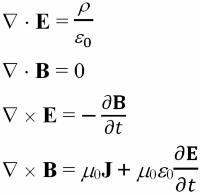
You really want to know how magnets work? Here you go:
Does God exist?
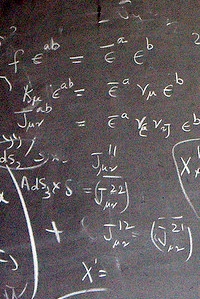
These are Maxwell’s equations, the foundation of our understanding of electricity and magnetism. A deep understanding would obviously take some effort, but the point is that this question is no mystery to science.
The song’s not all bad, but it wanders from justifiable wonder at nature (“Oceans spanning beyond my sight / And a million stars way above ’em at night”) to conflating wonder with ignorance.
Saturday Night Live did an excellent parody video. The lyrics in their song “Magical Mysteries” include, “Where does the sun hide at night? / Did people really used to live in black and white?” which isn’t too far from denying our knowledge about magnets.
Maybe Bill O’Reilly is a Juggalo (a fan of Insane Clown Posse) because he has sounded a lot like them. In a 2011 interview with David Silverman, president of American Atheists, O’Reilly said, “I’ll tell you why [religion is] not a scam, in my opinion. Tide goes in, tide goes out. Never a miscommunication. You can’t explain that.”
(Uh … can you say, “Wikipedia”?)
And were there no consequences for O’Reilly for being this confused about reality? He’s been lampooned for these statements (and a later defense, which was equally ridiculous) by people who weren’t his fans to begin with. But doesn’t his fan base care about reality? Can they possibly cheer on this willful ignorance?
Despite the contrary opinions of O’Reilly and Insane Clown Posse, learning about how things work can make them more amazing. Actually understanding how magnets work doesn’t ruin the magic trick, it turns mysterious into marvelous.
Here’s an experiment: go outside on a clear night. Hold out your hand, arm extended, and look at the nail of your little finger. That fingernail is covering a million galaxies. Not a million stars, a million galaxies. Each galaxy has roughly 100 billion stars. That’s 100,000,000,000,000,000 stars under just one fingernail. Now look at how vast the sky is compared to that one tiny patch.
And how does the Bible treat this inconceivable vastness? “[God] also made the stars” (Gen. 1:16). That’s it.
The god of the Old Testament is little more than an absolute monarch with the wisdom of Solomon, the generalship of Alexander, and the physical strength of Hercules. But science gives you the vastness of the universe, the energy of a supernova, the bizarreness of quantum physics, and the complexity of the human body. The writers of the Bible were constrained by their imagination, and it shows. There is so much out there that they couldn’t begin to imagine. If you want wonder, discard the Bible and open a science book.
And this is not groundless myth, it’s science—the discipline that makes possible your reading this across the Internet, on a computer, powered by electricity (and governed by Maxwell’s equations).
Carl Sagan said, “We are star stuff” to suggest that we are literally made from the remnants of stars. Two adjoining carbon atoms in a molecule in your body might have come from different exploding stars. Science gives us this insight, not religion.
Second-century Christian author Tertullian is credited with the maxim, credo quia absurdum (I believe because it is absurd). In other words, no one could make this stuff up.
If you believe anything either in spite of evidence to the contrary or because of it, science may not for you. But if you want to understand reality to the best of humanity’s ability, rely on science. C’mon in—the water’s fine!

Science does not make it impossible to believe in God,
but it does make it possible to not believe in God.
Steve Weinberg, Nobel Laureate in Physics

Photo credit: mutantMandias
Related posts:

Related links:

  • “Miracles” by Insane Clown Posse: video (cued to the magnets verse) and lyrics. Caution: rated PG-13 for language.
  • “F*cking Magnets, How Do They Work?” Know Your Meme.
  • “Bill O’Reilly You Can’t Explain That,” Know Your Meme.
  • Robert Quigley, “Bill O’Reilly’s Tidal Skepticism Launches ‘You Can’t Explain That’ Meme,” Geekosystem, 2/10/11.
  • A succinct summary of how modern technology makes the marvels of Jesus look pathetic is here.