
Word of the Day: Theory and Law

A novel of Christian apologeticsLet’s start with a few definitions within mathematics and logic. An axiom or postulate is a proposition (statement) taken as a given. A lemma is an intermediate proposition or stepping stone rather than the final result, which is a theorem. A corollary follows readily from a theorem—it’s often simply another way of stating the theorem. Lemmas, theorems, and corollaries are all proven, but proofs are only possible within mathematics and logic, not within science.
By contrast, all scientific statements are provisional. A scientific hypothesis is a testable explanation for a phenomenon. It explains and predicts. Once a hypothesis has proven itself, it becomes a scientific theory. A scientific law is a description of a natural phenomenon, often an equation. Laws and theories are both well-tested, widely or universally accepted within the field, and falsifiable. The main difference is that a theory explains while a law describes.
For example, germ theory, quantum theory, and the theory of evolution are explanations. Boyle’s law, Ohm’s law, and Newton’s law of gravity are all descriptions (and are all equations).
A common misconception is that scientific hypotheses mature to theories, which mature to facts or laws. Instead, facts (the observations from an experiment, for example) lead to hypotheses (a plausible but immature explanation), which lead to theories (well-evidenced explanations). In the category of scientific explanations, a theory is as good as it gets and it doesn’t graduate to become a law.
Photo credit: Marvin (PA)
Related posts:

Related links:

Don’t Like Abortion? Then Support Sex Education

There’s a reality disconnect within the pro-life community. They reject abortion while they also reject the solution to abortion, sex education. Is abortion an American Holocaust, as Ray Comfort says? If so, then join forces with the pro-choice camp and teach teens how to avoid it!
Being against abortion but rejecting sex education is like being against deaths through unclean water but rejecting sewer systems.
Here’s an excellent infographic on sex education from PublicHealthDegree.com. Pass it on.
Reproductive Health Education
Created by: PublicHealthDegree.com
Related posts:

16 Arguments Against Abortion, Addendum

Novel explores Christianity atheism apologetics themesThanks to the Prime Directive blog, I belatedly came across a long list of “Questions for Pro-Choice People” by Prof. Michael Pakaluk. I’ve already responded to most of them with the spectrum argument, but here are three extra questions taken from this list that explore new ground and are worth highlighting.
17. Imagine a woman seeing an ultrasound of her unborn baby. Sometimes the hands and feet are visible, and the baby is sometimes sucking its thumb. Why aren’t such images shown to women considering abortions as part of informed consent? Works for me. But let’s add conditions to make this practical.

  • This should be an option rather than part of a mandatory gauntlet forced on women considering abortion.
  • This should not be the first time the woman has seen this information. That is, education should teach about the stages of fetal development as part of comprehensive sex education that would minimize the chances of her having this unwanted pregnancy in the first place.
  • The woman’s choices should be made available as soon as possible. Putting obstacles in her way—by closing down nearby clinics, encouraging pharmacists to refuse to offer morning-after pills, and so on—increases the age of the fetus she must consider aborting. If an abortion is to happen, let’s make it early so that the woman doesn’t see a fetus sucking its thumb.

18. “Does anyone wish that his mother had chosen abortion for him? And, if not, then how can he consistently wish that any mother choose abortion for anyone else?” This is a more eloquent version of my question 4, in an earlier post.
In the first place, if I’d been aborted, I wouldn’t be here to care. In the second, this thinking isn’t far removed from the Quiverfull movement (my thoughts on that here), which encourages no restraint on birth and childishly “lets God decide” how many children to have.
Where do you draw the line? If we are morally obliged to bring to term a 2-week-old fetus, are we also morally obliged to bring to term the thought, “Gee, I wonder if we should have another baby …”?
Seeing life as a spectrum is the only way to make sense of this. Yes, that leaves unanswered the question of where to draw the line for abortion, but let’s first agree that a spectrum exists.
19. Let’s suppose that we’re doubtful that the unborn child is a human being with human rights (there is no doubt, but let’s imagine there is). Given this uncertainty, shouldn’t we err on the side of the child? I agree that there’s no doubt, but I’m sure my confidence is the opposite of yours.
A fetus is not a person. Play games with the name all you want (“The fetus is a Homo sapiens, ‘human being’ is simply a synonym, and if a fetus is a human being, it must have human rights!”), but there’s no ambiguity here. Despite your word games, a newborn baby is still not the same thing as a single cell. There is a spectrum.
Photo credit
Related posts:

Related links:

  • The text of the opinion in Roe v. Wade is available here. Though written in 1973, it gives a thorough analysis of both sides of the issue. Anyone who objects to this decision should probably know what this decision actually says.
  • William Saletan, “The Pro-life Case for Planned Parenthood,” Slate, 12/11/08.

Word of the Day: Haggard’s Law

Christianity and atheism, does God exist?Rev. O’Neal Dozier, a Rick Santorum backer, says that homosexuality is the “paramount of sins” and that it is “something so nasty and disgusting that it makes God want to vomit.”
Pastor Ken Hutcherson, here in Seattle, is against Washington state’s new law-in-waiting allowing same-sex marriage. He’s been riding this horse for years, ever since he complained about Microsoft offering health benefits to same-sex partners of employees.
Ted Haggard was the founder and former head of both the 10,000-member New Life Church and led the National Association of Evangelicals. In the movie Jesus Camp, he said, “We don’t have to debate about what we should think about homosexual activity. It’s written in the Bible.”
But Pastor Ted was brought low by claims that he had a long-term relationship with a gay prostitute. This hypocrisy gave us Haggard’s Law: the likelihood of someone’s being gay increases in proportion to the force of that person’s public objections to homosexuality. One wonders if the other pastors similarly doth protest too much.
The next time some guy with a religious or political platform bloviates about why a segment of society doesn’t deserve the same respect as everyone else, remember Haggard’s Law and wonder what he’s hiding.
Photo credit: Simon Varwell
Related posts:

Related links:

Does the Christian Care About the Poor or Not?

A novel about Christian apologetics and atheist counter-apologetics
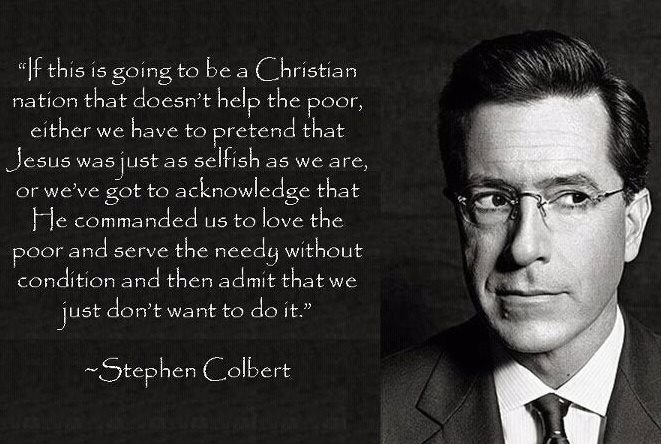
The New Testament is brimming with demands that the Christian care for the poor and needy.  Think of the parable of the Sheep and the Goats (Matt. 25:31–46), the parable of the Good Samaritan (Luke 10:25–37), or the story of Jesus and the rich young man (Luke 18:18–30).
How some politicians and religious leaders can juggle the hypocrisy is beyond me.  I’ll grant that the Bible can be picked apart and made to say just about anything, but isn’t charity a prime demand?

[Jesus said:] Go, sell everything you have and give to the poor, and you will have treasure in heaven. Then come, follow me. (Mark 10:21)
[John the Baptist said:] Anyone who has two coats should share with the one who has none, and anyone who has food should do the same. (Luke 3:11)
If anyone has material possessions and sees a brother or sister in need but has no pity on them, how can the love of God be in that person? Dear children, let us not love with words or speech but with actions and in truth. (1 John 3:17–18)
Religion that God our Father accepts as pure and faultless is this: to look after orphans and widows in their distress and to keep oneself from being polluted by the world. (James 1:27)

Word of the Day: Irreducible Complexity

A novel about Christian apologetics and atheismMicrobiologist Michael Behe coined the term “irreducible complexity” to describe a system in which every part is mandatory. Here is his definition:

By irreducibly complex I mean a single system composed of several well-matched, interacting parts that contribute to the basic function, wherein the removal of any one of the parts causes the system to effectively cease functioning.1

Let’s look at a popular example, the remarkable bacterial flagellum. Built of several dozen different proteins, this tiny motor with a whip-like appendage can propel a bacterium 60 cell lengths per second. Compare this to the cheetah, the fastest land animal, which sprints at 25 body lengths per second. (Here’s a good agenda-less video showing the structure of the flagellum.)
The irreducible complexity claim is this: imagine turning the clock of evolution back. Which protein was the last to be put in place? Remove any protein from the flagellum and it doesn’t function. So if one step back in time from the working flagellum was something useless, no matter which protein you remove, why would evolution have created this thing? Evolution doesn’t spend effort slowly building elaborate nonfunctioning appendages on the remote chance that with a few more mutations over 100,000 generations it might get lucky and create something useful. But Intelligent Design comes to the rescue by postulating a Designer that put everything together all at once.
We can topple this thinking by considering an arch. Which was the last stone to be put in place in an arch? If you try to turn the clock back by removing the central keystone, the arch falls. So that one couldn’t have been last. But try removing any stone from the arch and the same thing happens. This makes the arch irreducibly complex, using this Intelligent Design thinking, with a Designer levitating the stones into place all at once as the only explanation.
But of course this is nonsense. If you imagine watching a movie of the building of an arch played backwards, the first change you’d see was not a stone removed but the last piece of scaffolding put into place. Then the remainder of the scaffolding to support the stones, then the stones removed one at a time, and then the scaffolding removed.
In the same way, the step that preceded the bacterial flagellum might have been the removal of an unnecessary piece of scaffolding.
There is much more to say about why the idea of irreducible complexity has not won over the science of biology, including attacks on how good an example the flagellum is of irreducible complexity, but that is a tangent for this post. For more on this topic, check out the links below.
Science may well have unanswered questions regarding the origin of the flagellum, but “I don’t know” is no reason to invent a Designer. And you can be sure that once the origin of the bacterial flagellum is sufficiently well understood, this argument will be discarded like a used tissue and some other complex feature of biology (and there’s always something) will be seized upon by the Intelligent Design advocate as the wooden stake that will finally destroy the monster that is evolution.
If the past is any indication, our ID friend will have a very long wait.
1 Michael J. Behe, Darwin’s Black Box (Touchstone, 1996), p. 39.
Photo credit: harrymoon
Related posts:

Related links: