
Debate: Does God Exist?

Christian apologetics don't do much to support the notion that God exists“Does God Exist?” This was the topic at a public debate I attended on Monday. Here’s a brief summary. See how you would respond to the points that were raised.
The moderator started with Ian Barbour’s four criteria for assessing hypotheses:
1. Agreement with Data. We never have proof (outside of mathematics and logic), but we can provisionally accept the hypothesis that fits best with the data.
2. Coherence. A new hypothesis should be consistent with and support already-accepted theories. If not, it had better be a pretty compelling hypothesis. Simpler is better.
3. Scope. Broader is better.
4. Fertility. What new things can this hypothesis tell us? What predictions can it make? What new questions does it invite?
The two speakers were Lutheran pastor Gary Jensen (also a member of Reasons to Believe, an old-earth Creationist organization) and humanist and lawyer Jim Corbett.
I felt that Corbett won the event. Call me biased, but his arguments were much more concrete. Rev. Jensen was comfortable speaking to the crowd of roughly 200 people, but his arguments were shallow. I’ll do my best to give highlights of each speaker’s points. For Rev. Jensen, I’ll add occasional comments.
Jensen spent much of his opening statement speaking in what (to my mind) were tangential generalities: quoting famous people, asserting that we must follow the evidence wherever it leads (Socrates? Sartre?), showing how the Bible encourages a sensible interaction with nature, giving a summary of the progress of the modern cosmological view, and so on. He said that the Bible is the only religious story with a cosmic beginning. (Huh?)
He got to his first claim with a reference to the fine tuning argument, but he simply pointed to Just Six Numbers by Martin Rees. (Okay, that’s a data point, but it’s hardly an argument.)
In talking about cosmology, he threw in the term “Darwinism.” (Ouch—that may due to too much hanging out with the Reasons to Believe guys.)
He talked about God as a given and made a mistake that I see frequently—confusing statements about his beliefs (which he made) with an apologetic argument (which he didn’t).
He cited Sir William Ramsay’s argument that Paul’s journeys documented in Acts are accurately described and therefore the gospel story is likely also accurate. (No: that the names and places Paul documents are the least we’d expect of a book that claims to be historical. This is no argument that the supernatural claims are accurate. The Harry Potter books accurately refer to London, but that is no evidence that the supernatural elements are accurate.)
He cited Antony Flew’s There is a God as evidence of a smart person who changed his mind. (This was a mistake. I’ve read the book. First, it was ghost-written, and second, the arguments that supposedly turned Flew into a deist are scientific arguments. The critique by a non-scientist of scientific arguments is uninteresting to me.)
Modern science was hatched in a Christian culture. (Okay, and it was a carnivorous culture as well. So what? I see no cause and effect here. To argue that a Christian culture was necessary to birth Science, you must provide evidence.)
Jensen made a vague reference to professors “kicked out” for being Creationists and gave Guillermo Gonzalez as an example. (I wonder if he’s read the other side of the story. That there is another side doesn’t make Jensen’s claim wrong, but it is mandatory that he at least be aware of it.)
He says that he encourages free inquiry but that scientists who reject the supernatural are therefore closed-minded.
He referred to information in DNA (that some protozoa have 200 times the DNA that humans do shows that DNA isn’t “designed” as we use the term) and absolute morality (that we see considerable social evolution from biblical morality to today’s morality overturns this notion).
Corbett had some interesting points (any transcription errors are my fault):

  • We have a moral responsibility to treat supernatural claims with skepticism. Otherwise we open ourselves to every snake oil salesman.
  • Religion is the only impediment to science education in America, and science education is tied to national security.
  • We’ve found clues of python worship in Botswana from 70,000 years ago, our earliest evidence of God of the Gaps thinking—that is, God lives in the gaps where science says, “we don’t know.” In this pre-scientific world, this was understandable and even laudable. But in the 21st century, it’s inexcusable.
  • Lawrence Krauss called God of the Gaps thinking “cowardly.”
  • When Christianity was in charge, we called that the Dark Ages.
  • One imam helped stifle the Islamic Golden Age, and we’re seeing the same thing in America.

Corbett concluded with an interesting parallel. It took about 300 years from Christianity to go from having negligible impact (at the death of Jesus) to being the official religion of the Roman empire (by the Council of Nicaea). If you count Darwin’s Origin of Species as the beginning of modern atheism in the West, we’re halfway through our 300-year transition period. Polls indicate that religion is declining, new knowledge explains away God, and God of the Gaps thinking is no longer necessary.
I’m not sure if that should be seen as optimistic (we’re making good progress) or pessimistic (we have a long way to go) or even unrealistic (Christianity has weathered storms before and we mustn’t count it out), but it’s an interesting parallel.
Photo credit: YouTube
Related posts:

Related links:

“Cross Examined” Available on Kindle!

My novel is now available on Kindle, with more electronic formats in process.
If you haven’t heard about the book, here’s the one-liner: a young man takes a reluctant journey into the defense of Christianity and realizes that the truth of religion is something you must decide for yourself.
The book targets two audiences.  First, I want to give thoughtful Christians something to think about and to encourage complacent Christians to critique the foundations of their religion.  Many Christian leaders make exactly this point, that they too want to push Christians to think.  I think of the book as an intellectual workout—a taxing project, perhaps, but one that leaves the reader a stronger person.
Second, I want to reach atheists who might enjoy approaching these intellectual arguments in fiction rather than in the usual nonfiction form.
The book is set in Los Angeles in 1906, in an odd new church that is suddenly world famous.  The pastor’s prediction of imminent disaster had been front-page news the day before the great San Francisco earthquake—true story.  Here’s the back-cover summary:

In 1906, three men share a destiny forged by a prophecy of destruction.  That prophecy comes true with staggering force with the San Francisco earthquake and fire, and young assistant pastor Paul Winston is cast into spiritual darkness when his fiancée is among the dead.  Soon Paul finds himself torn between two powerful mentors: the charismatic pastor who rescued him from the street and an eccentric atheist who gradually undercuts Christianity’s intellectual foundation.

As he grapples with the shock to love and faith, Paul’s past haunts him.  He struggles to retain his faith, the redemptive lifesaver that keeps him afloat in a sea of guilt.  But the belief that once saved him now threatens to destroy the man he is becoming.

Paul discovers that redemption comes in many forms.  A miracle of life.  A fall from grace.  A friend resurrected.  A secret discovered.  And maybe, a new path taken.  He realizes that religion is too important to let someone else decide it for him.  The choice in the end is his—will it be one he can live with?

Cross Examined challenges the popular intellectual arguments for Christianity and invites the reader to shore them up … or discard them. Take the journey and see where it leads you.

Buy Cross Examined at Amazon today (270 pages, paperback, $11.95 or Kindle version, $2.99).
Related posts:

  • Read excerpts of the book here.

Churches and the Corporate Org Chart

(Today, I’m pleased to have a guest post from Richard S. Russell, an atheist from Wisconsin and commenter at this blog.)
In these difficult economic times, you may have heard more than usual about GDP. It’s short for “Gross Domestic Product” and is the dollar value of all the goods and services produced within a given country (or state or region) in a year. “Goods” are products, material objects that customers want; “services” are procedures, actions performed to help customers. Together, these products and procedures reflect the wealth generated by the economy.
In the U.S., a lot of goods and services are produced by big corporations, which are organized to do so effectively and efficiently, using those techniques much beloved of Econ 101 courses, division of labor and specialization.
Here’s an organization chart for a typical manufacturing corporation, one that produces material goods:

And here’s what goes on inside each of those little boxes:

(1) Management makes decisions, tells everyone else what to do, and handles investor relations.
(2) Internal Services support the rest of the company in general; the category includes accounting, info tech, personnel (human resources), labor relations (employment relations or ER), safety, maintenance, regulatory compliance, and legal.
(3) Research and Development (R&D) investigates new ways of doing things and tests them out.
(4) Purchasing acquires raw materials, equipment, and property.
(5) Manufacturing (the biggest part of the company, employing the most people) generates actual useful products.
(6) Inventory Control deals with both raw materials and finished products and includes transportation, warehousing, shipping, delivery, and quality assurance.
(7) Marketing uses media to spread the word that people should buy the company’s products.
(8) Sales works directly with individual customers to get them the products they want in exchange for their money.
(9) Customer Service works directly with customers who are having problems with a product.
The chart gets slimmed down a little if we’re talking about services instead of goods. Here’s an org chart for a typical service corporation:

Notice that manufacturing has vanished altogether (no goods being produced), and that the bulk of the people working for the company are the ones directly helping customers. You still have Purchasing and Inventory Control, but these are much smaller operations (since they now deal mainly with furniture and office supplies instead of heavy machinery and raw materials) and so are generally subsumed under Internal Services.

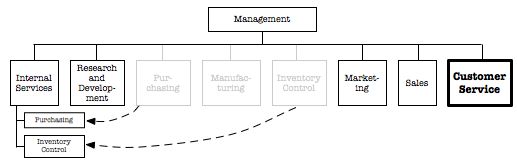
Finally we have the kind of organizations that produce neither goods nor services, namely churches. Here’s how they work:

There are still lots of entries under Management (bishops, archbishops, abbots, cardinals, popes, etc.), since these guys (by which I mean “men”) are really into hierarchy.

There’s the normal array of Internal Services, with the diminished activity under ER (no unions, heavy emphasis on conformity and obedience) and regulatory compliance more than offset by the need for lots of work under legal (discrimination, pedophilia, etc.).
Nothing under R&D. (Create something new?!)
Nothing under Purchasing. (Spend? Contribute to the economy?!)
Nothing under Manufacturing. (Useful products!?)
Nothing under Inventory Control.
But tons and tons o’ time is devoted to (or, more properly, “wasted on”) Marketing and Sales. In fact, in the absence of goods and services, it’s the only thing religion does at all. In other words, the priest class spends all its time pushing companionship with themselves, in return for nothing useful or even (as in the case of more traditional prostitutes) pleasurable.
The most telling part of the chart, though, is Customer “Service,” where the ironic quotation marks emphasize the difference between what a church does and what an actual contributor to GDP does. A responsible, reputable company assumes that, if you’ve got a problem, it’s their own product’s fault, or the result of shoddy service from one of the company’s representatives. But in the case of religion, any counseling they provide for people with problems is designed to show, first and foremost, how the religion itself is never, ever at fault, that the problem is entirely the customer’s, because he or she didn’t follow directions properly. In short, the motto of Customer “Service” for a church is “The customer is always wrong.”
In effect, since religion never solves any problems (not even those of its own making), Customer “Service” is just another mechanism under Sales and Marketing, which is why it’s shown as subsidiary to those activities on the skeletal org chart above.
You know the short word for any activity that’s all talk and no walk (or, as they say in Texas, all hat and no cattle)? Scam!
Related posts: