Dr Johnson: The Angel of Mons

Did you see the 1971 Disney movie Bedknobs and Broomsticks starring Angela Lansbury? Set in World War II, the Germans invade a peaceful British town, but a ghostly and invulnerable battalion of animated suits of armor from the local museum fights off this modern force.
This wasn’t just an active imagination on the part of the screenwriters. No, this came from history.

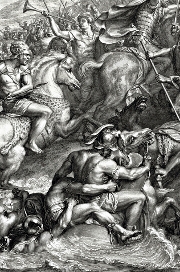
It was August of 1914, near Mons in Belgium. The German army was making its sweep into France in the opening stages of World War I. Heavily outnumbered units of the British Expeditionary Force came under vastly superior German fire, and their destruction seemed assured. But in perhaps the strangest tale in modern warfare, the British were saved at the last moment by an inexplicable heavenly presence: a brigade of warrior angels appeared and wrought destruction upon the Germans, handing the day and the victory to the British.

This is an excerpt from Skeptoid.com. The episode goes on to expose the myth, noting that the origin of the supernatural part comes the short story “The Bowmen” by Arthur Machen, published five weeks after the battle. Machen was inspired by the Battle of Agincourt, the miraculous and overwhelming English victory that took place almost exactly 500 years before the Battle of Mons. He imagined the ghosts of those English and Welsh archers using their fabled longbows to annihilate the Germans like they had done to the French cavalry when they were living.
Archers became angels with an article of supposed battlefield remembrances some months later, and the angelic story was solidified by several books years later. The story inspired Mary Norton, author of the two books from which Disney’s Bedknobs and Broomsticks was adapted.
Granted, the horde of angels was never part of any official account of the battle, and even within the British public during the war this was probably a minority belief. But similarly, the historical resurrection of Jesus was never part of any modern consensus view of history, and Christianity is a minority of worldwide belief (to cite just two groups, Roman Catholics are 16.8% and Protestants are 6.1% [2009 estimates]).
If some combination of outright fiction, selective memory, and wishful thinking can make it into the history of our well-educated modern era, shouldn’t this natural explanation win out over the supernatural Jesus story?
Photo credit: Lichfield District Council
Related posts:

Related links:

  • “Angels of Mons,” Wikipedia.
  • Brian Dunning, “The Angel of Mons,” Skeptoid, 1/20/09.

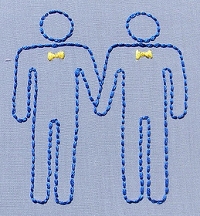
Gay Marriage Inevitable?

Jesus and God and apologeticsA century ago, America was immersed in social change. Some of the issues in the headlines during this period were women’s suffrage, the treatment of immigrants, prison and asylum reform, temperance and prohibition, racial inequality, child labor and compulsory elementary school education, women’s education and protection of women from workplace exploitation, equal pay for equal work, communism and utopian societies, unions and the labor movement, and pure food laws.

The social turmoil of the past makes today’s focus on gay marriage and abortion look almost inconsequential by comparison.
What’s especially interesting is Christianity’s role in some of these movements. Christians will point with justifiable pride to schools and hospitals build by churches or religious orders. The Social Gospel movement of the early 20th century pushed for corrections of many social ills—poverty and wealth inequality, alcoholism, poor schools, and more. Christians point to Rev. Martin Luther King’s work on civil rights and William Wilberforce’s Christianity-inspired work on ending slavery.
(This doesn’t sound much like the church today, commandeered as it is by conservative politics, but that’s another story.)
Same-sex marriage seems inevitable, just another step in the march of civil rights. Jennifer Roback Morse, president and founder of the Ruth Institute for promotion of heterosexual marriage and rejection of same-sex marriage, was recently asked if she feared being embarrassed by the seeming inevitability of same-sex marriage. She replied:

On the contrary, [same-sex marriage proponents] are the ones who are going to be embarrassed. They are the ones who are going to be looking around, looking for the exits, trying to pretend that it had nothing to do with them, that it wasn’t really their fault.
I am not the slightest bit worried about the judgment of history on me. This march-of-history argument bothers me a lot. … What they’re really saying is, “Stop thinking, stop using your judgment, just shut up and follow the crowd because the crowd is moving towards Nirvana and you need to just follow along.”

Let’s first acknowledge someone who could well be striving to do the right thing simply because it’s right, without concern for popularity or the social consequences. I would never argue that someone ought to abandon a principle because it has become a minority opinion or that it is ridiculed. If Dr. Morse sticks to her position solely because she thinks it’s right, and she’s not doing it because of (say) some political requirement or because her job depends on it, that’s great.
Nevertheless, the infamous 1963 statement from George Wallace comes to mind: “I say segregation now, segregation tomorrow, segregation forever.” That line came back to haunt him. To his credit, he apologized and rejected his former segregationist policies, but history will always see him as having chosen the wrong side of this issue.
Christianity has similarly scrambled to reposition itself after earlier errors. Christians often claim that modern science is built on a Christian foundation, ignoring the church’s rejection of science that didn’t fit its medieval beliefs (think Galileo). They take credit for society’s rejection of slavery, forgetting Southern preachers and their gold mine of Bible verses for ammunition. They reposition civil rights as an issue driven by Christians, ignoring the Ku Klux Klan and its burning cross symbol, biblical justification for laws against mixed-race marriage, and slavery support as the issue that created the Southern Baptist Convention.
Mohandas Gandhi had considerable experience as the underdog. He said, “First they ignore you, then they ridicule you, then they fight you, then you win.”
(And then they claim that it was their idea all along!)
The same-sex marriage issue in the United States has almost advanced to “then you win” stage. Check back in two decades, and you’ll see Christians positioning the gay rights issue as one led by the church. They’ll mine history for liberal churches that took the lead (and flak) in ordaining openly gay clerics and speaking out in favor of gay rights.
If someone truly rejects same-sex marriage because their unbiased analysis shows it to be worse for society, great. But it is increasingly becoming clear how history will judge that position.

Truth never damages a cause that is just.
— Mohandas Gandhi

Photo credit: Spec-ta-cles
Related posts:

Related links:

  • “Dr. Jennifer Roback Morse, Are Defenders of Natural Marriage on the Wrong Side of History?” Issues Etc., 5/25/12.
  • “Pure Religion: Revivalism and Reform in Early 19th-Century America,” The Dartmouth Apologia, Spring 2010, pp 20–24.

Word of the Day: Russell’s Teapot

does god exist?A couple posts ago, we talked about unicorns. There are other things that we pretty much know don’t exist. Some of these were deliberately invented—for example, the Flying Spaghetti Monster, sacred to Pastafarians worldwide, or the Invisible Pink Unicorn, or the new church of Kopimism.
But before those was Bertrand Russell’s teapot.
Bertrand Russell proposed the idea of a teapot orbiting the sun between the Earth and Mars in 1952. The teapot is too small to detect with any instrument, so it’s impossible to prove this claim wrong.
Russell pushes the teapot contention to the limit:

But if I were to go on to say that, since my assertion cannot be disproved, it is intolerable presumption on the part of human reason to doubt it, I should rightly be thought to be talking nonsense. If, however, the existence of such a teapot were affirmed in ancient books, taught as the sacred truth every Sunday, and instilled into the minds of children at school, hesitation to believe in its existence would become a mark of eccentricity and entitle the doubter to the attentions of the psychiatrist in an enlightened age or of the Inquisitor in an earlier time.

How valid is the comparison of God with an orbiting teapot? We know that there are teapots, and we know how to put things into solar orbits. It’s just technology, and an orbiting teapot violates no scientific laws. But the God hypothesis is far bolder because it demands a new category, that of supernatural beings. They may exist, but science acknowledges no examples.
Is there such a teapot? Maybe, but why live as if there is? We can’t invalidate the teapot hypothesis, but that’s not the same as proving it true or even showing that it’s worthy of consideration.
We don’t give equal time to the orbiting teapot hypothesis, so why give equal time to similar claims that are equally poorly evidenced, like God?
Photo credit: Wikipedia
Related posts:

Related links:

Word of the Day: Shibboleth

existence of GodThe Hebrew word shibboleth literally means “torrent of water” or “ear of corn.” But its use in English comes from a clever wartime trick from the Bible.
Chapter 12 of the book of Judges records intertribal warfare between the tribe of Ephraim (on the west of the Jordan River) and the territory of Gilead (on the east side). At the end of the battle, the Gileadites captured the fords of the Jordan. To identify the Ephraimites, they demanded that everyone wanting to cross into Ephraim say the word, “shibboleth.” The Ephraimite dialect of Hebrew had no “sh” sound, and for them it came out as “sibboleth.” The Gileadites identified and killed 42,000 Ephraimites with this trick.
The word shibboleth can mean a truism or widely held belief, but the more interesting definition is an identity test or litmus test or test of belonging.
For example, “Unless you are circumcised, according to the custom taught by Moses, you cannot be saved” (Acts 15:1). Circumcision becomes a shibboleth.
The Taxpayer Protection Pledge, a public promise to never raise taxes, has become a shibboleth for Republican politicians.
Tattoos might be a shibboleth for a motorcycle gang, and a style of clothing or makeup might be a shibboleth for a high school clique.
The atheist community has shibboleths as well. Like any such test, they can be too quickly used to dismiss potential members. For example, the typical American atheist is in favor of same-sex marriage, is pro-choice, is liberal, and is a Democrat. But I know atheists who don’t fit each of these labels, and I’d hate to see them shunned or have their (different) voices and ideas shut down.
Consider the case of Bill Maher, the writer of the documentary Religulous (2008). He was the winner of the Atheist Alliance International’s 2009 Richard Dawkins award. This caused a stir within the atheist community because, while his popular film was a powerful credential, Maher has rejected vaccinations in some circumstances. His atheist credentials were in doubt because he had fallen victim to some of the biases that atheists dislike in those who accept superstitions or religion.
Shibboleths have their place, but make sure they don’t replace a thoughtful and reasoned analysis with a knee-jerk response.
Photo credit: Wikimedia
Related posts:

Related links:

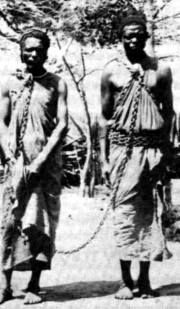
Biblical Slavery, Part 3

(See Parts 1 and 2 of this discussion.)
Let’s conclude this critique of a podcast titled “Sex, Lies & Leviticus” from apologetics.com that responded to Dan Savage’s criticism of the Bible. Italicized arguments are my paraphrases from the podcast.
Slavery doesn't make the Bible look too goodDan Savage and other atheists distort the Bible by imagining it supporting slavery. If Southerners used the Bible to support slavery during the Civil War, that was only because they distorted it. Consider the anti-slavery books of that time: The Bible Against Slavery (1837) or God Against Slavery (1857), for example.

Let’s consider the Southern Baptist Convention, America’s largest Protestant denomination. It split with northern Baptists in 1845 because it insisted on maintaining its support for slavery. In 1995, on the 150th anniversary of the split, it published a resolution that repudiated racism and slavery. (Good for them for admitting their error, though the delay puts this correction in the same bin as the Catholic Church’s tardy embrace of Galileo in 1992.)
Looks like support for slavery is a plausible message to take from the Bible even if not everyone accepts it.
Were there anti-slavery books at that time? Were there Christians against slavery? Sure! How that gets the Old Testament off the hook, I can’t imagine. The verses quoted in the previous post show that the Bible is very plainly pro-slavery.
Consider Philemon, a short book in the New Testament. Here Paul sends a slave back to his master Philemon with the request that he be “no longer as a slave, but better than a slave, as a dear brother” (Philemon 1:16). This was radical stuff—it was designed to bring about change within the Roman slave system.
Wow—that’s wishful thinking. If Paul shouted in public, “Don’t you get it? Owning another person is wrong! Free all slaves immediately!” that wouldn’t have changed the Roman system. Paul instead asking in a private letter that one slave be freed wouldn’t change the system, and it’s not clear he’s even asking for this.
Abraham Lincoln convulsed America in a Civil War, in part, to free the slaves. Jesus didn’t lift a finger to overturn slavery. In fact, the New Testament is full of pro-slavery statements.

Slaves, obey your earthly masters in everything. (Col. 3:22)
Slaves, in reverent fear of God submit yourselves to your masters, not only to those who are good and considerate, but also to those who are harsh. (1 Peter 2:18)
All who are under the yoke of slavery should consider their masters worthy of full respect. (1 Tim. 6:1–2)
Teach slaves to be subject to their masters in everything. (Titus 2:9–10)
Were you a slave when you were called [to be a Christian]? Don’t let it trouble you. … Each man, as responsible to God, should remain in the situation God called him to. (1 Cor. 7:20–24)

The Christian can respond with nice verses in the Old Testament—“Love your neighbor as yourself” (Lev. 19:18), for example—but here again the Bible makes a clear distinction between Jewish neighbors and those other guys. So back to Dan Savage and his claim that the Bible is radically pro-slavery: looks to me like Savage wins. Whenever Christians make a careful distinction between Jewish slaves in the Old Testament and African slaves in America, they’re playing games.
Let’s take a step back to see where we’ve been. On this podcast, two well-educated Christians spent an hour trying to shoehorn actual biblical slavery (that is: slavery for life; slavery not too bad considering that slaughter was the alternative; beatings okay unless the slave is incapacitated; etc.) into a package labeled “indentured servitude.” They pretended that biblical slavery was far, far different from the slavery in America.
It makes you wonder if they’d be happy to see this godly biblical institution in effect here in America. (Maybe when the theocracy comes?)
I don’t know whether to be offended that they think I’m so uninformed that I don’t see the deception or to be amazed that they honestly don’t understand.
But that’s not the crazy part. Halfway through the second hour, the host and guest acknowledged the irony that they are both African-Americans.
So we have two African-American men defending slavery. One of them likened biblical slavery to an “employment contract” (again, he seemed blind to the fact that the six-year Jewish slavery is not the interesting topic). “We’re in a form of slavery when we’re working on a job for somebody else,” he said. Uh, no—being a waiter is not even close to being a slave. When people complain that it’s the same, they’re exaggerating. Yes, we’re constrained when we’re employees, but who seriously equates present-day employment in America to the abhorrent kind of slavery we’re talking about?
So a white guy has to remind modern-day African-Americans on the problems of slavery. Wow. This is what Christianity can do to people. It makes them check their brains at the door—not all Christians, of course, but some. They defend the morality of biblical slavery, if such a thing can be imagined. They reject science for creationism. They support torture in proportion to their religiosity. They reject stem cell research and the best methods for preventing unwanted pregnancy. They dismiss the injustice of eternal torment in hell by saying, “Uh … the gates of hell must be locked from the inside!” They dismiss evidence that televangelists are charlatans. They rationalize away biblical genocide.
Slavery is a bad thing, and the Bible condones slavery. Dan Savage was right. Just admit it.

Morality is doing what is right regardless of what we are told.
Religious dogma is doing what we are told regardless of what is right.
Andy Thomson at American Atheists 2009 conference

Photo credit: Wikimedia
Related posts:

Word of the Day: Cottingley Fairies

In 1917, two girls spent much of their summer playing by a stream. Repeatedly scolded for returning home wet and muddy, they said that they were playing with fairies. To prove it, they borrowed a camera and returned claiming that they had proof. That photo is shown here.
A total of five photos were taken over several years. The fairies were called the Cottingley fairies after Cottingley, England, the town where the girls lived.
A relative showed two of the photos at a 1919 public meeting of the Theosophical Society, a spiritualist organization. From there, Sir Arthur Conan Doyle, a devotee of spiritualism, took the baton. He wrote a 1920 article in The Strand Magazine that made the photos famous. To his credit, Conan Doyle asked experts to critique the photos. The opinions were mixed, but he decided to go with the story anyway.
Spiritualism, the popular belief that we can communicate with the spirits of the dead, was waning at the time of the article. Magician Harry Houdini, annoyed by fakers using tricks to defraud the gullible, devoted much time to debunking psychics and mediums in the 1920s until his death in 1926.
Houdini and Conan Doyle had been friends, but the friendship failed because of their opposite views on spiritualism. Conan Doyle believed that Houdini himself had supernatural powers and was using them to suppress the powers of the psychics that he debunked.
Research in 1983 exposed details of the Cottingley hoax, and the two principles finally admitted that they had faked the fairies by using cardboard cutouts of drawings copied from a book.
I learned of a modern parallel to this hoax at The Amazing Meeting in 2004. James Randi told the story of Project Alpha, during which he planted two fake psychics (Steve Shaw and Michael Edwards, actually talented amateur magicians) in the McDonnell Laboratory for Psychical Research in 1979. Randi contacted the researchers before planting his fakes to caution them how to avoid being deceived. The advice was thorough and genuine, and if they’d followed it, they would have uncovered the trickery.
Two years later, after the lab’s successes were well known within the psychic community and the fake psychics were celebrities, the deception was made public. The press was so bad that the McDonnell laboratory shut down.
The moral of the story: unless you’re a magician, don’t pretend that you can expose a magician. Said another way, just because you’re smart (and let’s assume both that the researchers were smart and most skeptics are smart), don’t think that you can’t be duped. This was Conan Doyle’s failing.
Magician Ricky Jay said, “The ideal audience would be Nobel Prize winners. … They often have an ego with them that says, ‘I am really smart so I can’t be fooled.’ No one is easier to fool.”

If you believe in the existence of fairies at the bottom of the garden,
you are deemed fit for the [loony] bin.
If you believe in parthenogenesis, ascension, transubstantiation and all the rest of it,
you are deemed fit to govern the country.
— Jonathan Meades

Photo credit: Wikimedia
Related posts:

Related links:

  • Paul Hoffman, “Why Are Smart People Some of the Most Gullible People Around?” Discover, 2/10/11.
  • “Cottingley Fairies,” Wikipedia.
  • “The Derbyshire Fairy,” Museum of Hoaxes.
  • Emma Clayton, “Photographic expert uncovered hoax after testing cameras used by Cottingley cousins,” Telegraph & Argus, 11/17/10.