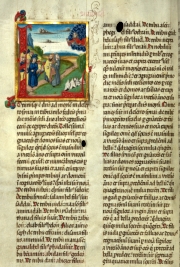
 We’re taking a trip through time, from our English New Testament, back through the translations and various copies (Part 1), back through the textual variants to our best guess at the original Greek manuscripts (Part 2). We’ve arrived at our best reconstruction of the canon determined by the Council of Nicaea (325 CE).
The novel The Da Vinci Code portrayed the Council as the stereotypical politicians’ smoky back room where the features of Christianity and the books that represented it (the canon) were haggled over. Many Christian sources have argued against this characterization, saying that the canon had largely been decided by the early churches by that point, but this doesn’t avoid the problem. Selecting the canon would’ve been a popularity contest either way. If the bishops at Nicaea didn’t vote it into existence, then the weeding-out process in the early church created a de facto canon that the bishops accepted with minimal change. Either way grounds the canon on the imperfect shoulders of ordinary people.
Let’s take the next step. We have a big gulf to cross from 325 CE to roughly 70–90 CE, when the originals were written down.
Suppose that Mark was written in Rome in the year 70. Copies are made and it gradually makes its way to Alexandria, where it is copied over and over until it finds its way into the Codex Sinaiticus in about 350. What happened to it in those 280 years? How does the version that we have vary from the original manuscript, now lost to history? That’s a lot of time for hanky-panky.
The issue isn’t that I’m certain that the books were changed significantly; rather, we aren’t certain that they weren’t. This period from Nicaea back to the originals is the Bible’s Dark Ages, a period with very little documentation. We have just a few dozen Greek manuscripts that precede the complete codices. The papyrus manuscripts are all fragments, containing at most a chapter or two of one book. These manuscripts are remarkable finds, but that does nothing to change the fact that we’re bridging a large gap with little information. We can’t say that our copies differ little from the originals because we don’t have the originals.
This biblical Dark Ages was a period of much turmoil in the Christian community. The divisions in early Christianity were much bigger than the modern Lutheranism vs. Presbyterianism distinction, say. Instead of French vs. Spanish, think French vs. pre-Columbian Mayan. And these divisions were all fighting for survival, fighting for their place in the canon.
Historians know of four primary divisions in the early Christian church.
Proto-Orthodox. This is Bart Ehrman’s term for the early Christian sect that would become Christianity as we know it today. Paul’s writings (which changed Jewish law to reject circumcision, the kosher laws, and so on) form the heart of this division.
Ebionites. These may have been the first Christians, because they saw Jesus as a Jew. This was the Jesus who said, “Do not think that I have come to abolish the Law or the Prophets” (Matt. 5:17). The New Testament documents the struggles between the James/Peter sect and Paul in Galatians 2:11–21. Bart Ehrman’s Misquoting Jesus says,
According to the Ebionites, then, Jesus did not preexist; he was not born of a virgin; he was not himself divine. He was a special, righteous man, whom God had chosen and placed in a special relationship to himself.1
Marcionites. This Christian variant was put forward by Marcion in about 144 CE. The Marcionites had no use for the Old Testament, since it documented the Jews’ god, who was different from the (unnamed) father of Jesus. Marcion argued that you could answer to Yahweh if you wanted, but Jesus offered a much better option. This Jesus was divine and only appeared to be human. Consider John 20:26: “Though the doors were locked, Jesus came and stood among them.” Marcion considered only Paul’s writings to be canonical.
Gnostics. The Gnostics rationalized the evil in the world by saying that the world was created by a demiurge (craftsman) who didn’t intend to or wasn’t able to create a perfect world. While most people on the earth were just animals, some held a divine spark. For that special few, Jesus’s hidden knowledge would be necessary after death to see them safely back to heaven. We see this in Luke 8:10: “The knowledge of the secrets of the kingdom of God has been given to you, but to others I speak in parables, so that, ‘though seeing, they may not see; though hearing, they may not understand.’”
Biblical redaction is the deliberate change or concatenation by a later editor, and the Bible is full of examples. For example, the Old Testament has two creation stories, two flood stories, two contradictory Ten Commandments (Exodus 20 vs. 34), and even two David and Goliath stories.
The New Testament holds clues to this kind of change as well. For example, John ends with chapter 20 and then again with chapter 21.2 The authorship of Peter’s two epistles is unclear. Jesus says, “But about that day or hour [of the end] no one knows, not even the angels in heaven, nor the Son, but only the Father” (Matt. 24:36), but some scribes omitted the startling phrase “nor the Son” from their copies.
The Ebionite, Marcionite, and Gnostic passages above suggest that our Bible is a conglomeration of different traditions, with verses or chapters added as necessary to dull the edge of an unwanted concept.
This isn’t meant to be a thorough discussion of New Testament redaction. Rather, I want to show just a few places where it is suspected and to suggest that it could have been even more widespread. Claims as remarkable as those of the gospels must be built on more than “Well, they might not have been changed.”
The message of James differs from the message of Paul; the message of Paul differs from the message of Acts; the message of the Revelation of John differs from the message of the Gospel of John; and so forth. Each of these authors was human, each of them had a different message, each of them was putting the tradition he inherited into his own words.3
Would writings be deliberately changed? The author of Revelation apparently knew it was widespread enough to end with a curse against anyone who would modify his book. The famous Testimonium Flavianum in Josephus (“Now there was about this time Jesus, a wise man, if it be lawful to call him a man …”) is almost universally said to have been added by later copyists. With the pull of competing Christianities, the urge to “improve” a book might have been irresistible.
Would competing writings be destroyed? It happened in Islam. The “Uthmanic recension” was the process through which one version of the Koran was accepted and all competing versions destroyed. The Nag Hammadi library seems to have been buried. Why hide these books unless there was reason to fear destruction? Perhaps, like the Koran, the Bible has been modified through destruction.
While historians have told us a remarkable amount about the societies from which Christianity arose, our understanding is changing even in our time. For example, consider “Gabriel’s Revelation,” a recently discovered first century BCE writing that talks about a suffering messiah, not Jesus but Simon of Peraea. “In three days you will know that evil will be defeated by justice.” Do we conclude from this that resurrection after three days wasn’t a new concept to the Jesus-era Jews? In this revelation, the messiah sheds blood, not for the benefit of sinners but for the redemption of Israel.
Of course we don’t discard the clues we have about the original New Testament documents, but let’s proceed with humility about how little we can say with confidence.
Read the first post in the series here: What Did the Original Books of the Bible Say?
Next time: the last post in the series will take the step from gospel originals to the figure of Jesus.
1 Bart Ehrman, Misquoting Jesus (HarperOne, 2005), p. 156.
2 Ehrman, 61.
3 Ehrman, 215.
Photo credit: Walter Noel
 I can’t count the number of times that I’ve said something like, “I accept evolution because it’s the scientific consensus” and gotten the response, “Gotcha! Argument from Authority Fallacy!”
 I’m a big fan of Dr. Robert Price’s Bible Geek podcast as many of you know. If you’re interested in the Bible and the culture from which it came, this podcast is a fire hose of information. His other (more recent) podcast is
  The term “survival of the fittest” did not initially come from Charles Darwin’s Origin of Species, though later editions did use it. It was first coined by Herbert Spencer, after reading Origin.
 Easter has recently passed, and I’d like to rerun a post on the resurrection.