
Claims that Prayer Cures Disease

green blogs--bacteria under a microscopeWashington recently declared a state epidemic for pertussis (whooping cough). Pertussis hasn’t been this bad in Washington for decades. The number of cases (close to 2000) is already ten times the number from last year.
Before routine child vaccination in the 1940s, pertussis caused thousands of fatalities annually in the U.S.
You might imagine that this is a story about anti-vaxers, afraid of a perceived vaccine-autism link, who have refused to vaccinate their children and helped create this epidemic. Not this time. The anti-vaccine movement seems not to be a factor.
Instead, the interesting angle on this story is not disease prevented by vaccine but disease prevented by prayer. Kingdom League International, an online ministry based in western Washington, says in a brief article titled “Whooping Cough Epidemic Halted in Jefferson County”:

Churches in Jefferson County [one of those hardest hit by the statewide epidemic] used our strategy to mobilize prayer and establish councils to connect in 7 spheres of society.* On Mar 27 they met and a County Commissioner asked them to pray about the whooping cough epidemic. … As of April 13 there has not been one case reported. From epidemic proportions to zero.

A bold claim, but the only evidence is that of the improvement in statistics. The elephant in the room, of course, is whether we can find natural explanations besides prayer to explain the facts. And, of course, we can. Epidemics peak and then diminish, particularly when there’s an effective health system in place that can administer vaccines. There were 21 confirmed cases for this county in 2012, with no new cases since mid-April. Is this remarkable? Is this unexplained by the efforts of the public health system? Looks to me like an epidemic that’s simply run its course.
Not surprisingly, I jumped into a discussion with the author in the comment section. Aside from being asked my faith status (though I’m not sure how this affects one’s ability to evaluate evidence), I got the expected tsunami of miracle claims—a bad knee healed, a barren woman now pregnant, lung cancer cured, demons cast out, blindness healed, a stroke patient recovering, a rainstorm to break a heat wave, a cracked rib healed, and so on.
(For comparison, consider the pinnacle of medical cure sites, Lourdes.  After 150 years as a pilgrimage site and with six million visitors per year, the Catholic Church has recognized just 67 miraculous cures.)
I pointed out to my Kingdom League correspondent that natural explanations hadn’t been ruled out.  Surprisingly, there was no interest in doing so.
I tried to portray this as a missed opportunity. If these claims are more than just anecdotal, then this group should create a dossier of x-rays, test results, photographs, or other evidence, both before and after the miracle. Add the report of the doctor who witnessed the change and then show this to the Centers for Disease Control or an epidemiologist or some other qualified authority. Why hide your light under a basket? Jesus had no problem using miracles to prove his divinity (John 10:37–8).
There seems to be no shortage of these miracles (at least in their minds), so if one miracle claim isn’t convincing, then pray for some more and try again to convince the skeptics.
That this group has no interest in going beyond feel-good anecdotes makes me think that they understand that their claims wouldn’t withstand scrutiny, not because skeptics wouldn’t play fair, but because honestly evaluating the claims would show them to be little more than wishful thinking.

Pray v. To ask the laws of the universe to be annulled
on behalf of a single petitioner confessedly unworthy.
— Ambrose Bierce, The Devil’s Dictionary

Addendum 6/1/12: After further discussion with the author of the KLI article, he reminded me that links in the comment section give more than anecdotal information, including this article in the Southern Medical Journal.
*KLI focuses on the Dominionists’ Seven Spheres of Influence.
Photo credit: AJC1
Related posts:

Related links:

Word of the Day: Public Square

Remember John F. Kennedy’s famous speech assuring the public that his Catholicism would not affect his decisions as president? While Rick Santorum was still a candidate for president, he said about Kennedy’s speech:
Earlier in my political career, I had the opportunity to read the [Kennedy] speech, and I almost threw up. You should read the speech.

Hold on to your lunch, because we’re going to do just that. Here’s the central theme in what JFK said to the Greater Houston Ministerial Association in 1960:

I believe in an America where the separation of church and state is absolute—where no Catholic prelate would tell the President (should he be Catholic) how to act, and no Protestant minister would tell his parishioners for whom to vote—where no church or church school is granted any public funds or political preference—and where no man is denied public office merely because his religion differs from the President who might appoint him or the people who might elect him.

Santorum, who, like JFK, is Catholic, critiques this thinking as follows:

Kennedy for the first time articulated the vision saying, “No, faith is not allowed in the public square. I will keep it separate.” Go on and read the speech.

When asked about the throwing up bit, he elaborated:

To say that people of faith have no role in the public square? You bet that makes you throw up. What kind of country do we live that says only people of non-faith can come into the public square and make their case? That makes me throw up.

Huh? The guy is a lawyer, a two-time U.S. Representative, and a two-time U.S. Senator. Does he really not get it? I suppose the most charitable assumption is that he’s just playing to his electorate.
There are two meanings to “public square,” and Santorum confuses (or deliberately conflates) them here. The First Amendment establishes our free speech rights and, with some exceptions, we can say whatever we want in the literal public square. Hand out religious leaflets on a street corner. Stand on a soap box and preach like they do in Hyde Park. Wear a sign proclaiming the end of the world. Everyone agrees that the right that allows people of faith to speak in the public square is important. It is not under attack, and atheists defend Christians’ right to speak as strongly as Christians do.
The other public square is the government-supported public square—schools, courthouses, government buildings. The rules are different here. The First Amendment constrains government when it says, in part, “Congress [that is: government] shall make no law respecting an establishment of religion.”
Government must stay out of religion. No prayers or religiously motivated science in public schools. No Moses holding the Ten Commandments glaring down at you in a courtroom (as a collection of historic lawmakers, this is okay). No “In God We Trust” as a motto behind the city council (yeah, I know that we have that, but it’s still unconstitutional).
And isn’t this best for the Christian as well? No Wiccan or Satanist prayers in public schools. No Hindu god of jurisprudence glaring down from the courtroom wall. No “Allahu Akbar” in Arabic script behind the city council.
Keeping government out of the public square helps the Christian as much as it does the atheist.
Photo credit: Wikipedia
Related posts:

Related links:

Conference Notes

Why imagine that there is a god?I recently returned from the Orange County Freethought Alliance conference. Though a local conference, it had an impressive lineup. Of course, they had an advantage with some well-known Los Angeles-area speakers: Michael Shermer (Skeptic magazine), Phil Zuckerman, Jim Underdown, Brian Dunning, Mr. Deity (Brian Dalton), Eddie Tabash, and Heina Dadabhoy (Muslim blogger at Skepchick.org). But they also had some great out-of-towners: Robert Price, Aron Ra, Richard Carrier, Barbara Forrest (expert witness in Kitzmiller v. Dover), David Silverman, and Dan Barker (FFRF).
I’ll give some (probably disjointed) highlights.
David Silverman, president of American Atheists, said that the next Reason Rally is scheduled for 2016 (location unknown). He also said that Fox News has reported that they will become more centrist.
Lawyer Eddie Tabash emphasized that the next president will almost surely pick a Supreme Court justice to replace Justice Ginsberg (now 79 years old) at least. He spoke about being at the recent $15 million Obama fundraiser hosted by George Clooney. When he got his two minutes with Obama, Tabash quipped, “I am the first atheist in history to be in the presence of his savior.”
To emphasize the judicial predicament that thoughtful Americans are in, he gave this fun quote:

Disfavoring practicing homosexuals in custody matters promotes the general welfare of the people of our State. … The State carries the power of the sword, that is, the power to prohibit conduct with physical penalties, such as confinement and even execution. It must use that power to prevent the subversion of children toward this lifestyle, to not encourage a criminal lifestyle… Homosexual behavior is a ground for divorce, an act of sexual misconduct punishable as a crime in Alabama, a crime against nature, an inherent evil, and an act so heinous that it defies one’s ability to describe it.

That’s Alabama Supreme Court judge Roy Moore referring to a 2002 custody case involving a lesbian mother. He was later removed from office after refusing to remove a stone monument of the Ten Commandments from the courthouse. (Perhaps that humiliation is a selling point to some voters since he’s the favorite to regain his former job this November.)
In June 2005, Justice Antonin Scalia stated that

The [First Amendment’s] Establishment Clause … permits the disregard of devout atheists.

And Clarence Thomas has said that the Establishment Clause limits only the federal government, not state governments. That is, in his mind state governments aren’t bound by the constraint to “make no law respecting an establishment of religion.”
Sounds more like April Fool’s Day than that these are the considered opinions of state and federal Supreme Court justices.
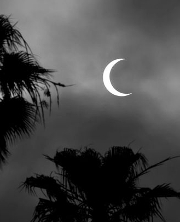
On a lighter note, Brian Dunning (Skeptoid podcast) gave a puzzle. The full moon is the same size as what held at arm’s length? Is it a ball bearing, a pea, a dime, a nickel, a quarter, a silver dollar, a plum, or a baseball? (The answer is below.) This was an especially apt puzzle since we had a spectacular partial (80%) solar eclipse at the end of the conference.
Dunning gave himself as an example of how tenacious false beliefs can be. After he concluded that vitamin C had no effect on colds, it took a year to wean himself off of it. This is like Greta Christina’s gradual acceptance of the lack of evidence for glucosamine as joint medicine or Sam Harris’s Fireplace Delusion. It helps to understand our own blind spots when we try to understand those of other people.
Richard Carrier, newly famous because of his online argument with Bart Ehrman about the Jesus Myth theory, talked about the fine-tuning argument. It was a good talk and especially helpful because I’d read Vic Stenger’s The Fallacy of Fine-Tuning and hadn’t gotten the concise summary that I was hoping for. I’ll leave a more detailed summary of this talk for later.
Michael Shermer talked about “The Moral Arc of Reason.” He noted that asking, “Why should we be good without God?” is like asking “Why should we be hungry (or jealous or happy or any other human feeling) without God?” These are all natural feelings with plausible natural causes.
He used graphs and statistics to argue that things are getting better within society (wars, income, and other social metrics), much like Steven Pinker’s The Better Angels of Our Nature. But why is this not simply an aberration? Why imagine that this is a legitimate trend within society and not cherry picking of the data? Shermer argued for a moral equivalent of the Flynn Effect, the startling effect that has caused an increase in average IQ scores of about three points per decade, perhaps for as long as a century. The Flynn Effect has been (tentatively) explained with the hypothesis that modern society has trained us to be better in abstract reasoning (mentally moving 3D shapes, for example). Perhaps there is a moral equivalent at work as well, that modern society has given us a new appreciation for peace and harmony.
I have long been fascinated with the work of Phil Zuckerman, who (along with Gregory Paul) has shown the far better social metrics of less-religious countries compared to the religious U.S. Zuckerman talked about the new Secular Studies major he developed at Pitzer.
Barbara Forrest of SE Louisiana University, an expert witness in the Dover trial, says that “critical analysis of evolution” and “academic freedom” are some of the new creationist code words.
Jim Underdown is a paranormal investigator who will be on Dr. Phil debunking psychics this week (“Inside the Other Side,” 5/25/12). He noted that the Bible’s miracle claims are similar to today’s paranormal claims, which have been tested and debunked. The one million dollar JREF prize for a successful paranormal demonstration remains unclaimed, for example.
The answer to Brian Dunning’s puzzle: the full moon is the same size as a pea held at arm’s length. My guess was a dime, so I need to try this myself to verify it.
Played at the conference, here’s Jesus singing “I will survive” (a must-see if you haven’t watched this before).

Photo credit: Mirror

Yet Another Conference …

Can Christianity stand to the atheists' super powers?I’m off to the Freethought Alliance Conference in Irvine, CA this weekend, so I’ll be a little slow with blog posts for a few days.
This should be an interesting event, with a Who’s Who of atheist speakers—Michael Shermer, Robert Price, Phil Zuckerman, Aron Ra, Richard Carrier, Brian Dunning, Mr. Deity, Dan Barker, Eddie Tabash, and others.  I’d like to put copies of my book into the hands of some of these speakers.  I’m sure that most won’t read it, but I want to add to my collection of positive reviews and hope that this increases the chance that someone will open doors for the book.
As an aside, has anyone noticed that there are more atheist/freethought conferences lately?  I’m fairly new to this game—the first conference that I attended in this category was The Amazing Meeting 2 in 2004.  But this could simply be my being more aware of them.  Let me know if you sense that conferences have changed in the last decade, either on the freethought side or the Christian side.
Photo credit: Wikipedia

Debate: Does God Exist?

Christian apologetics don't do much to support the notion that God exists“Does God Exist?” This was the topic at a public debate I attended on Monday. Here’s a brief summary. See how you would respond to the points that were raised.
The moderator started with Ian Barbour’s four criteria for assessing hypotheses:
1. Agreement with Data. We never have proof (outside of mathematics and logic), but we can provisionally accept the hypothesis that fits best with the data.
2. Coherence. A new hypothesis should be consistent with and support already-accepted theories. If not, it had better be a pretty compelling hypothesis. Simpler is better.
3. Scope. Broader is better.
4. Fertility. What new things can this hypothesis tell us? What predictions can it make? What new questions does it invite?
The two speakers were Lutheran pastor Gary Jensen (also a member of Reasons to Believe, an old-earth Creationist organization) and humanist and lawyer Jim Corbett.
I felt that Corbett won the event. Call me biased, but his arguments were much more concrete. Rev. Jensen was comfortable speaking to the crowd of roughly 200 people, but his arguments were shallow. I’ll do my best to give highlights of each speaker’s points. For Rev. Jensen, I’ll add occasional comments.
Jensen spent much of his opening statement speaking in what (to my mind) were tangential generalities: quoting famous people, asserting that we must follow the evidence wherever it leads (Socrates? Sartre?), showing how the Bible encourages a sensible interaction with nature, giving a summary of the progress of the modern cosmological view, and so on. He said that the Bible is the only religious story with a cosmic beginning. (Huh?)
He got to his first claim with a reference to the fine tuning argument, but he simply pointed to Just Six Numbers by Martin Rees. (Okay, that’s a data point, but it’s hardly an argument.)
In talking about cosmology, he threw in the term “Darwinism.” (Ouch—that may due to too much hanging out with the Reasons to Believe guys.)
He talked about God as a given and made a mistake that I see frequently—confusing statements about his beliefs (which he made) with an apologetic argument (which he didn’t).
He cited Sir William Ramsay’s argument that Paul’s journeys documented in Acts are accurately described and therefore the gospel story is likely also accurate. (No: that the names and places Paul documents are the least we’d expect of a book that claims to be historical. This is no argument that the supernatural claims are accurate. The Harry Potter books accurately refer to London, but that is no evidence that the supernatural elements are accurate.)
He cited Antony Flew’s There is a God as evidence of a smart person who changed his mind. (This was a mistake. I’ve read the book. First, it was ghost-written, and second, the arguments that supposedly turned Flew into a deist are scientific arguments. The critique by a non-scientist of scientific arguments is uninteresting to me.)
Modern science was hatched in a Christian culture. (Okay, and it was a carnivorous culture as well. So what? I see no cause and effect here. To argue that a Christian culture was necessary to birth Science, you must provide evidence.)
Jensen made a vague reference to professors “kicked out” for being Creationists and gave Guillermo Gonzalez as an example. (I wonder if he’s read the other side of the story. That there is another side doesn’t make Jensen’s claim wrong, but it is mandatory that he at least be aware of it.)
He says that he encourages free inquiry but that scientists who reject the supernatural are therefore closed-minded.
He referred to information in DNA (that some protozoa have 200 times the DNA that humans do shows that DNA isn’t “designed” as we use the term) and absolute morality (that we see considerable social evolution from biblical morality to today’s morality overturns this notion).
Corbett had some interesting points (any transcription errors are my fault):

  • We have a moral responsibility to treat supernatural claims with skepticism. Otherwise we open ourselves to every snake oil salesman.
  • Religion is the only impediment to science education in America, and science education is tied to national security.
  • We’ve found clues of python worship in Botswana from 70,000 years ago, our earliest evidence of God of the Gaps thinking—that is, God lives in the gaps where science says, “we don’t know.” In this pre-scientific world, this was understandable and even laudable. But in the 21st century, it’s inexcusable.
  • Lawrence Krauss called God of the Gaps thinking “cowardly.”
  • When Christianity was in charge, we called that the Dark Ages.
  • One imam helped stifle the Islamic Golden Age, and we’re seeing the same thing in America.

Corbett concluded with an interesting parallel. It took about 300 years from Christianity to go from having negligible impact (at the death of Jesus) to being the official religion of the Roman empire (by the Council of Nicaea). If you count Darwin’s Origin of Species as the beginning of modern atheism in the West, we’re halfway through our 300-year transition period. Polls indicate that religion is declining, new knowledge explains away God, and God of the Gaps thinking is no longer necessary.
I’m not sure if that should be seen as optimistic (we’re making good progress) or pessimistic (we have a long way to go) or even unrealistic (Christianity has weathered storms before and we mustn’t count it out), but it’s an interesting parallel.
Photo credit: YouTube
Related posts:

Related links: