
Parallels to Christians’ Selective Use of Science

Advanced Test Reactor at Idaho National Laboratory (the blue glow is Cherenkov radiation)The film Pandora’s Promise (2013, 86 minutes, $4) explores nuclear power as it interviews prominent environmentalists who switched from being against it to being in favor. I’d like to highlight some of the features of the transition these environmentalists went through. There are surprising parallels with the transition people make when leaving Christianity, and there are parallels between a dogmatic anti-nuclear attitude and a dogmatic religious attitude.

The charges against nuclear power

Dr. Hellen Caldicott (a medical doctor) is used as the representative of anti-nuclear environmentalism. She has been called “the world’s foremost anti-nuclear campaigner.” She has received many prizes, 21 honorary doctorates, and a nomination for the Nobel Peace Prize by Linus Pauling and has been called by the Smithsonian Institution “one of the most influential women of the 20th Century.”

Caldicott uses nuclear accidents to make her case and claims that 985,000 people died as a result of the 1986 nuclear accident at Chernobyl. She says that the 2011 Fukushima power plant accident will be even worse. Seven million will die in the next two decades, and tens of millions more will suffer from “debilitating radiation-induced chronic illnesses.”

And the rebuttals

The World Health Organization disagrees. About Fukushima, it concluded in 2013, “The increases in the incidence of human disease attributable to the additional radiation exposure from the Fukushima Daiichi NPP accident are likely to remain below detectable levels.” No deaths due to radiation have been attributed to the accident.

Caldicott’s source for the nearly one million deaths due to Chernobyl has been widely discredited. A consortium of United Nations organizations and others said about the Chernobyl disaster:

According to [the United Nations Scientific Committee on the Effects of Atomic Radiation] (2000), [Acute Radiation Syndrome] was diagnosed in 134 emergency workers. … Among these workers, 28 persons died in 1986 due to ARS. … Nineteen more have died in 1987–2004 of various causes; however their deaths are not necessarily—and in some cases are certainly not—directly attributable to radiation exposure.

There were no radiation deaths in the general population, though there have been close to 7000 cases of thyroid cancer among children. These would have been “almost entirely” prevented had the Soviet Union followed simple measures afterwards.

The report estimates an increase in cancer mortality due to radiation exposure of “a few per cent” in the 100,000 fatal cancers that would be expected in this population.

In other words, Caldicott is about as wrong as it is possible to be. This is not to dismiss the problem—the Chernobyl and Fukushima nuclear accidents were indeed disasters—but it doesn’t help to see them incorrectly. The Fukushima earthquake and tsunami caused 16,000 deaths, while the power plant accident caused none.

Not seeing the problem correctly causes its own problems. The World Health Organization concluded twenty years after Chernobyl that “its psychological impacts did more health damage than radiation exposure did,” and childhood obesity in the Fukushima area is now the worst in Japan because children are not allowed to play outside, in most cases without any valid reason.

Environmentalists—aren’t they the ones who should be following the science?

One critic compared environmentalists with climate change deniers.

Failing to provide sources, refuting data with anecdote, cherry-picking studies, scorning the scientific consensus, invoking a cover-up to explain it: all this is horribly familiar. These are the habits of climate change deniers, against which the green movement has struggled valiantly, calling science to its aid. It is distressing to discover that when the facts don’t suit them, members of this movement resort to the follies they have denounced.

I find this topic revealing because anti-nuclear attitudes are typically held by liberals. Instead of using science and technology to find solutions to the problems of nuclear power, some liberals simply want it to go away. But these problems have solutions. For example, the Integral Fast Reactor was an experimental fourth-generation reactor program begun in 1984. It was cancelled ten years later by Democratic pressure, after it had proven that it was failsafe (it survived a loss of electrical power and loss of all coolant) and shown that it could reduce the waste leaving the facility to less than one percent that of conventional reactors.

The mothballing of the reactor cost more than letting the project conclude. Democrats can be as mindlessly ideological as Republicans.

While the U.S. civilian nuclear power industry has caused no deaths, the U.S. health burden from fossil fuel power generation is 30,000 to 50,000 premature deaths per year. Worldwide, the total is perhaps millions per year.

Breaking free

Some of the interviewees spoke of their change of mind. Mark Lynas said, “I was under no doubt that my whole career and my whole reputation as an environmental activist, communicator was at risk if I talked publicly about having changed my mind about nuclear power.”

Richard Rhodes said, “I came to realize [journalists] basically avoided looking at the whole picture. They only looked at the questions that seemed to prove to them that nuclear power was dangerous, as I had, too.”

I was most shocked at how little some of these environmentalists knew about nuclear power. They had their standard line—nuclear power of any type was bad—and they stuck with it. One career environmentalist admitted that he hadn’t known about natural background radiation from the ground, from space, and even from bananas. Natural potassium, of which bananas are a good source, is 0.012% potassium-40 (a radioactive isotope), and humans are more radioactive because of potassium than because of carbon-14.

Comparison with Christianity

Dr. Hellen Caldicott, the strident anti-nuclear activist, has a lot in common with Christian leaders. (Obviously, her opinion of religion isn’t the issue. I’m simply paralleling her actions with those of Christian leaders.)

  • Dogmatic. Caldicott is a charismatic speaker, and she has a ready audience eager to hear her message. She’s “the world’s foremost anti-nuclear campaigner” for a reason. She says that nuclear power is wicked just like a televangelist might say that same-sex marriage in America is wicked. She says that nuclear power of any type is bad, just a preacher might say abortion of any type is bad.
  • Confident and unchanging. Caldicott is well aware of this controversy and the fact that her figures are orders of magnitude greater than the most widely accepted data. Her position is at least grossly out of touch with reality and could even be called hysterical. But she uses this notoriety to her advantage, and I imagine her façade is as confident as ever.
  • Reputation. This is her livelihood and her identity, and she’s not likely to change. Like Harold Camping or John Hagee in the Christian domain, she can’t admit a big mistake. Some career environmentalists do change, though, as the film documents, and the soul-searching crisis that individual environmentalists endure parallels that of ex-Christians like Dan Barker, Bart Ehrman, or Matt Dillahunty. Leaving one’s identity in either domain means reinventing or even re-finding oneself, and former allies may ridicule or shun.
  • Embrace of science. Caldicott is like William Lane Craig and other apologists in that neither feels bound by science. They use science as it suits them. Caldicott is outraged that climate change deniers dismiss environmental dangers by ignoring or selecting their science, but then she does it herself. In the same way, William Lane Craig quotes cosmologists to defend the Big Bang (because he likes a beginning to the universe), but he ignores quantum physics when it says that events needn’t have causes (he’s desperate to find a cause for the universe).

I’m starting to worry that reason is an acquired taste.
— Sam Harris

Photo credit: Idaho National Laboratory

Argument from Design BUSTED!

The Argument from Design (the Teleological Argument) says that life looks designed. For example, we marvel at the cell’s tiny protein-building machines. Some bacteria have flagella that propel them at twice the proportionate speed (body lengths per second) of a running cheetah. A single microscopic cell is able to divide and differentiate into a full-grown oak or zebra or human.

William Paley famously said over two centuries ago, “The marks of design are too strong to be gotten over. Design must have had a designer. That designer must have been a person. That person is God.”

We must avoid the temptation, however, to imagine that complexity implies design. Elegance might, but mere complexity (especially unnecessary or sloppy complexity) gives little support for design. The cell, marvelously complicated though it is, may be more a Rube Goldberg machine than the elegant and sophisticated product of an omniscient designer.

What Does the Argument from Design Mean?

The Argument from Design imagines that we see the hand of a designer. All right, then: what would that look like? The only designers we know are human designers. (Let’s ignore the possibility of animal designers.) The Argument from Design then says: life looks like it would if made by a human designer with sufficient capability.

Consider the design criteria human designers use. A bridge might be designed for unusually high loads, so strength would be most important in this design. Or maybe speed of assembly is an important criterion. Maybe the bridge is remote, so it should have a long life or be maintenance free. Maybe it must use local materials. Maybe it’s in the middle of a town or city, so beauty is important.

These goals—strength, speed of assembly, durability, constraints on materials, and beauty—are some of the criteria designers might follow. But a criterion you never find in a human design is that the finished product should have added junk.

You may not like the Art Deco decorations at the top of the Chrysler building, but they were put there deliberately to follow the criterion of beauty. You may find a design that was poorly built or left unfinished, but that was never a goal of the designer. Useless junk is never in a design on purpose.

Contrast this with the crap that DNA has in it (as discussed in a recent post). Human DNA has a broken vitamin C gene in every cell as well as 20,000 other nonworking pseudogenes. Eight percent of our genome is composed of nonworking junk injected by viruses over millions of years. Atavisms (archaic genes that are accidentally switched on, like human tails) and vestigial structures (such as eyes in cave fish) are flashbacks to body features from species in the distant past. Onions have much more DNA than humans do, as do lots of other plants and animals, so either they need many times more DNA than humans or their genome has a lot of junk.

The Christian Response

The first argument Creationists often make is that made by Jonathan Wells in The Myth of Junk DNA. He argues that we keep finding new uses for fragments of human DNA that we previously thought were nonfunctional. Okay, so the fraction that we think is useless will decrease. Will it go to zero? Will we find that onions really do need five times more DNA than humans? There is no reason to imagine this, and junk DNA lives on.

The Design Argument says that life looks as if an omnipotent human designed it. It’s clearly wrong. DNA, the marvelous molecule that apologists point to as evidence of a designer, looks unlike anything that any sober designer would make. DNA alone is enough to sink the Design Argument.

Note that you can’t just say that life is impressive or amazing or marvelous or complex. True or not, that would be irrelevant. These attributes could apply to lots of things—crystals are complex and snowflakes are amazing and rainbows are marvelous, but they weren’t created by a designer. You must show how life follows design rules that a designer (and the only examples of designers that we have are human ones) would have followed.

Christian response #2: I guess that just shows that God has a broad palette. Tidy DNA or sloppy DNA, clearly these organisms work. I’m not complaining.

Yes, they work, but don’t make the Designer Argument to explain them. Richard Dawkins observed that Paley was doing good work, given that he was writing fifty years before Darwin’s On the Origin of Species, and that he would likely have been on board with evolution if given the chance.

3. Intelligent Design proponent Stephen Meyer said, “DNA functions like a software program. We know from experience that software comes from programmers.”

Not really. Some software comes from programmers, and some comes from random processes. Genetic programming evolves software like evolution evolves life forms. Competing versions of a program are randomly mutated and then selected for fitness, all within a computer. The winning programs in such an evolutionary process are the sloppiest software imaginable—not at all what a human would design, but reminiscent of DNA.

Evolution’s random mutation + selection can make lots of things. Here’s a simulation of random polygons added to an image selected to look like Mona Lisa. Here’s an evolution of random parts selected to make a car.

4. But DNA is information! Show me an example of information not coming from intelligence. Show me information not coming from a mind.

Show me an example of intelligence or a mind that’s not natural. Science recognizes no supernatural examples of anything, let alone intelligence and mind. We’re back to square 1, with supernatural claims without good reason to believe them.

But to your point, the examples of evolutionary software given earlier show information coming from a non-intelligent process. If you say that the software was intelligently designed, that’s true, so ignore the software. Make this a thought experiment. Imagine random polygons being added with a selection process that defines “fitness” as “looks like the Mona Lisa.” The software simply makes the thought experiment tangible.

5. Suppose I have dents in my car. Obviously, they’re imperfections of the design, but they weren’t put there by the designer. Just ignore them. Similarly, imperfections in DNA are no criticism of the Designer.

If your blue 2003 Honda Civic has dents, we can find a blue 2003 Civic without those dents to use as our standard of perfection. What’s the equivalent for human DNA? There is no perfect example to imagine that our DNA descended from.

There simply is no human DNA without pseudogenes, and the fact that some protozoa have 400 times more DNA than humans remains.

Where’s the evidence that going back in time, you find perfect DNA? Was human DNA perfect 3000 years ago when the stories that became the Bible began to be collected? Was it perfect in our last common ancestor with chimpanzees six million years ago? Was it perfect in the animals that came out of the Cambrian Explosion more than 500 million years ago? Science breathlessly awaits your evidence.

6. God’s design was perfect initially, but the Fall—that whole snake-and-apple thing—caused the imperfections in life that we see today.

Why would a human failing cause sloppiness in non­-human DNA? Anyway, this is irrelevant. It simply accepts that life doesn’t look designed, and the Design Argument fails. There is no perfect human DNA except in the imagination of this apologist.

7. Ah, but God is inscrutable. We don’t understand his ways. He designs in his own way that might seem bizarre to us.

If God’s handiwork is so bizarre that it doesn’t look like the work of any designer, then don’t make the Design Argument!

8. But you haven’t proven that God doesn’t exist.

Sure, God might exist. God might use evolution to carry out his plan. God might be a clockmaker who touched off the Big Bang and walked away. The focus of this post was simply to show the flaws in the Design Argument.

Does God exist? Maybe, but the Design Argument, which says that we see in life the attributes of design, is no tool by which to make the case.

There’s one thing the Bible makes clear: 
The biblical God is a sloppy manufacturer. 
He’s not good at design, he’s not good at execution. 
He’d be out of business if there was any competition.
— Contact by Carl Sagan

(This is an update of a post that originally appeared 1/21/13.)

Atheism Fails Because There Is No Ultimate Justice?

Christian apologist Greg Koukl in a recent podcast (“Bobby Conway – Doubting toward Faith”) raised the issue of ultimate justice. With this topic, he thinks he’s found a winner.

I think the problem of justice is a double down for us because not only is there no justice executed in an atheistic worldview, which is trouble, but there is no justice in an atheist worldview in the sense that the word can’t get any traction. The word justice itself, which requires that there is a right and proper end for those who do what is wrong, entails objective right (justice) and objective wrong, which are categories which don’t even exist in a naturalistic worldview, so in a certain sense they have a double problem with the issue of justice. (@11:05)

Koukl identifies atheists’ “double problem” with justice as (1) there is no ultimate justice within an atheist worldview and (2) the word justice itself makes no sense without objective morality to ground it.

I wonder how many things are wrong in this one brief paragraph. Let’s count them.

Note that this isn’t the introductory paragraph to a longer discussion. This is Koukl’s entire argument, so I’m not strawmanning his position by responding to just this paragraph.

1. We can’t let Hitler get away with it … but is the Christian view any better?

The idea of Hitler starting World War II and then using suicide as an escape with no further consequences frustrates Koukl. If you do the crime, you should do the time. But Christians themselves don’t do the time. They claim that accepting the sacrifice of Jesus gets them a suspended sentence and a ticket into heaven, so what happened to justice?

Maybe that’s how it worked with Hitler. Hitler was raised Catholic. Suppose in his final hours in the bunker, he returned to his roots, accepted Jesus into his life, asked for forgiveness, and then pulled the trigger. He’d be up in heaven right now playing shuffleboard with Jesus, and to hell with justice.

2. God’s mercy conflicts with his justice.

Koukl likes to imagine everyone getting what’s coming to them. But God doesn’t do it that way. When God gives justice, we get what we deserve, but sometimes he gives mercy and we get less than what we deserve. So which is it?

Christians celebrate both mercy and justice, but they can’t apply at the same time.

3. God’s justice is not modern justice.

God’s primitive justice may have made sense in the time of Jesus, but it is ridiculous from a modern standpoint. God, the perfect judge, apparently is too dull-witted to conceive of anything but two options: perfect bliss in heaven and perfect torment in hell. That’s it.

That’s not “justice” by any definition used by people here on earth. “The punishment fits the crime” is something that we imperfectly strive for here on earth, but God doesn’t even bother trying.

4. There’s no evidence for objective morality or ultimate justice.

Koukl said, “The word justice itself … entails objective right and objective wrong, which are categories which don’t even exist in a naturalistic worldview.” Koukl is right, but while the Christian worldview does imagine objective morality, it’s nothing more than wishful thinking.

Look up morality or justice in the dictionary. There is no objective, ultimate, absolute, or transcendental anything in the definitions. Not only does the dictionary argue against him, but Koukl doesn’t make any meaningful case for objective morality. Admittedly, he didn’t have the opportunity to argue for objective morality here, but he’s had it in the past and provided nothing compelling. I’ve dissected Koukl’s childish view of objective morality in prior posts.

5. The claim is that Christianity is useful, but wishing it were true doesn’t make it so.

Koukl doesn’t like the atheistic or naturalistic worldviews, but he makes no argument that Christianity is true or atheism false. I think atheism as a worldview is invigorating and empowering, but Koukl is making no argument against the accuracy of atheism. At the top of my list of 25 Stupid Arguments Christians Should Avoid, was “The consequences of atheism are depressing.”

6. What’s the point? The Bible makes clear that we’re all good.

Paul said, “For just as through the disobedience of the one man the many were made sinners, so also through the obedience of the one man the many will be made righteous” (Romans 5:19). We’re tarred with Adam’s brush, but we’re made clean by the sacrifice of Jesus.

Paul says we’re all righteous, Hitler included. So much for Koukl’s justice.

Science has never killed or persecuted a single person
for doubting or denying its teachings,
and most of these teachings have been true;
but religion has murdered millions for doubting or denying her dogmas,
and most of these dogmas have been false.
— George P. Spencer

Image credit: Evan, flickr, CC

The Design Hypothesis, DNA, and Dysteleology

DNA DesignDysteleology is the idea that life or nature does not show compelling evidence of design, in contrast to the Christian perception of purpose or design (teleology). The marvelous complexity in DNA is often cited by Creationists as the best evidence for their position. The facts tell a different story, and DNA makes clear that life looks more haphazard than designed.
Let’s consider four aspects of DNA that make it look not designed.

1. DNA Size

Human DNA has 3.42 billion base pairs. You might imagine that humans need the most DNA since the gods in Genesis said, “Let us make man in our image,” but we’re not even at the top of the list of mammals. Cows, mice, and bats have more.

And mammals don’t have as much DNA as other animals. One kind of salamander has 126 billion base pairs in its DNA. Does it really need 37 times more DNA than humans? Or could there be a lot of (dare I say it?) “junk” in that DNA?

We find much variability in fish DNA. The longest DNA (for the marbled lungfish) is almost 400 times the size of the smallest (the green puffer fish).

There are grasshoppers, beetles, ticks, worms, and snails that have more DNA than we do. There are plants that have more than we do—the onion, for example, has five times more. The record holder, with 400 times more DNA than humans, is a protozoa.

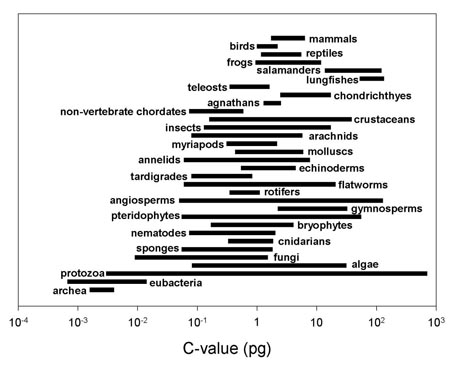
The wide variability in DNA size is shown in this chart:

c values

This is a logarithmic chart of the weight, or c-value (a proxy for DNA length), of the DNA of many categories of animals. Humans are in the “mammals” category at the top.

Maybe DNA is all useful and length is proportionate to the complexity of the organism. Maybe many animals are just more complex than we are, but then how can Man be God’s greatest creation? The alternative explanation is that there’s a lot of waste in DNA, but that rejects the idea of a designer. Neither is a good option for the Creationist.

2. Pseudogenes

All mammals synthesize vitamin C. They produce it internally and don’t have to eat it. All mammals, that is, except a handful, such as humans. We get scurvy if we go too long without eating vitamin C.

When you look in human DNA, you find a pseudogene (a broken gene) for vitamin C production, right where most other mammals have a functioning gene. Apparently, ancestors of humans and a few other primates once ate a diet rich in vitamin C so that a random mutation that broke the gene didn’t convey a selective disadvantage. The pseudogene spread through the population, and here we are, with every cell carrying a useless gene.

We find another example of a useful gene that didn’t have enough survival value to be selected for in the Antarctic icefish, which has no hemoglobin (the oxygen transport molecule) because of the oxygen-rich Antarctic water.

Smell is an area where humans have many pseudogenes. Of our roughly 100 odorant receptor genes, most don’t work. Many other mammals have working versions of these pseudogenes. At the other end of the scale is the dolphin, which has no working odorant receptor genes. They’re all pseudogenes.

Overall, human DNA has 20,000 pseudogenes—again, not evidence of the hand of a designer.

3. Endogenous Retroviruses

A virus can’t reproduce by itself and must force a cell to do it, which causes disease. Where it gets weird is when the virus infects a germ cell (egg or sperm). Then the viral DNA, inactivated by mutation, is passed on to succeeding generations. Becoming part of the genome is the “endogenous” part.

DNA keeps a record of these invasions. Human DNA has thousands of endogenous retroviruses, mostly just fragments, which compose up to 8% of our genome. One, the 5-million-year-old “Phoenix virus,” has been reconstructed from human DNA.

4. Atavisms and Vestigial Structures

Birds don’t have teeth, but their theropod dinosaur ancestors did. In fact, the ancient genes for teeth are still present in bird DNA. Scientists have been able to tweak chicken DNA to turn on these genes and get chickens with conical, dinosaur-like teeth.

When archaic genes are switched on in nature, those are called atavisms. Snakes can have legs, dolphins can have a hind pair of limbs, and humans can have tails.

Vestigial structures are those that have lost most or all of their ancestral function. Note that they’re not necessarily useless (Creationists delight in pointing out the value in the human appendix or tailbone); they’re just not used for what they were originally used for. For example, ostrich wings are vestigial because they can’t be used to fly (that’s what wings do).

Other examples are eyes in blind mole rats or cave fish, the pelvis (for nonexistent legs) in the baleen whale, and goose bumps (to raise nonexistent fur) in humans.

None of this proves that God doesn’t exist. What it does make clear is the difference between complexity, which we see in DNA, and evidence of a careful and skillful designer, which we don’t.

Yes, evolution by descent from a common ancestor is clearly true. 
If there was any lingering doubt about the evidence from the fossil record, 
the study of DNA provides the strongest possible proof 
of our relatedness to all other living things.
— Francis Collins, evangelical Christian and head of NIH

(This is an update of a post that originally appeared 1/16/13.)

Photo credit: U.S. National Library of Medicine